
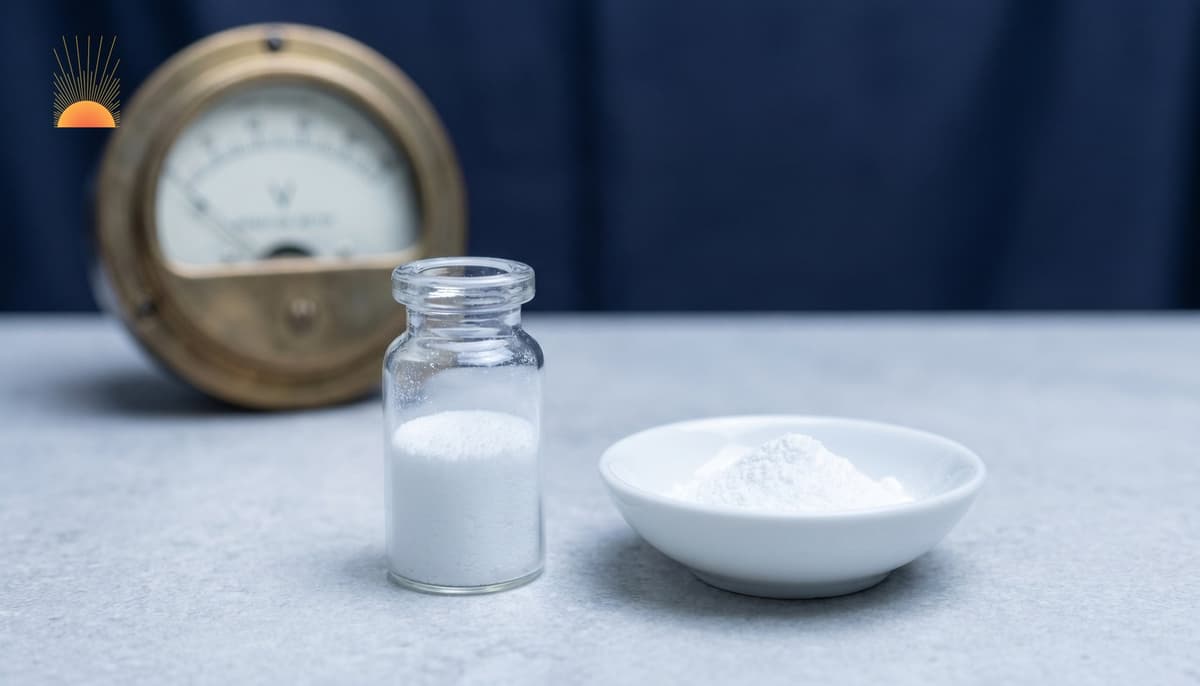
Potassium iodate (KIO3) is a stable-iodine thyroid blocker used to protect against radioactive iodine released in a nuclear or radiological emergency. It does one job exceptionally well — and for the health ministries and civil-protection agencies building stockpiles across MENA, Africa, and Latin America, its real advantage over the more familiar potassium iodide is not clinical. It is that it survives years of storage in hot, humid conditions where the alternative degrades.
What Potassium Iodate Protects Against
A reactor accident or certain radiological events release radioactive iodine, chiefly iodine-131. When inhaled or ingested, the thyroid gland cannot tell radioactive iodine from ordinary dietary iodine and absorbs it concentratedly — which is why radioiodine exposure is strongly linked to thyroid cancer, particularly in children. Stable-iodine prophylaxis works by saturating the thyroid with safe iodine in advance, so there is no spare capacity to take up the radioactive form, which is then excreted instead of stored. Both potassium iodate and potassium iodide deliver that protective iodine; the World Health Organization sets out when and how stable iodine should be used.
Thyroid blocking protects one organ against one isotope. It does nothing against cesium, thallium, or external radiation — which is why stable iodine is one component of a stockpile, never the whole of it.
Potassium Iodate vs. Potassium Iodide: Same Job, Different Chemistry
Both compounds are equally effective at blocking radioactive-iodine uptake when given in equivalent iodine doses. The practical difference is chemical stability. Potassium iodide is hygroscopic — it draws in moisture and can lose iodine over time in hot, humid storage. Potassium iodate is far more stable and holds its iodine content reliably across long shelf lives, which is why a number of national programmes in warm climates stockpile KIO3. The full comparison is set out in our guide to potassium iodide vs. potassium iodate.
WHO Age-Based Dosing
The protective dose is defined by the amount of stable iodine, which scales down with age. The table below gives the WHO single-dose stable-iodine bands with their potassium iodate and potassium iodide equivalents. Final dosing always follows national protocol and the treating clinician.
| Age group | Stable iodine | Potassium iodate (KIO3) | Potassium iodide (KI) |
|---|---|---|---|
| Adults & children over 12 | 100 mg | 170 mg | 130 mg |
| Children 3–12 years | 50 mg | 85 mg | 65 mg |
| Infants 1 month – 3 years | 25 mg | ~42 mg | 32 mg |
| Neonates (birth – 1 month) | 12.5 mg | ~21 mg | 16 mg |
Neonates, infants, children, and pregnant and breastfeeding women are the highest-priority groups, because the developing thyroid is the most vulnerable to radioiodine. Adults over 40 derive the least benefit and carry the most risk from the iodine load, so prophylaxis is prioritised accordingly.
Why Timing Decides Effectiveness
Stable iodine is overwhelmingly a single-dose, time-critical intervention. It is most effective taken shortly before or at the moment of exposure, and its benefit falls off quickly once radioactive iodine has already been absorbed by the thyroid. Repeat dosing is given only on the instruction of public-health authorities. This timing reality is precisely why pre-positioned stock matters: a protective agent that has to clear customs after the plume has passed offers no protection at all.
Why KIO3 Suits Institutional Stockpiles
For procurement teams in warm and humid regions, potassium iodate's stability is a logistical advantage that translates directly into preparedness value. Tablets that hold their potency for years reduce re-procurement cycles, simplify rotation, and lower the risk of discovering degraded stock at the worst possible moment. That makes KIO3 a natural fit for the kind of multi-year, distribute-and-forget stockpiling that ministries, defence medical services, and large institutions need — alongside emergency-response kits and the broader emergency preparedness posture now being formalised across MENA and Africa.
One Isotope, One Antidote — Build the Whole Set
Stable iodine is essential, but it is deliberately narrow: it shields the thyroid from radioactive iodine and nothing more. A credible radiological stockpile pairs it with a decorporation agent for internal contamination with radioactive cesium — Prussian blue — and the broader range of countermeasures that different exposure pathways demand. Planning the thyroid-protection layer is the right place to start, but it should be planned as one layer of several.
For procurement teams the requirements are consistent across the set: pharmaceutical-grade material to a recognised pharmacopoeia, WHO-GMP manufacturing, documented stability for long-term storage, and a supplier able to support institutional volumes and re-certification. Golden Hour Pharma positions its potassium iodate, potassium iodide, and full nuclear emergency antidote range against exactly those criteria.
Stability Is What Turns Stock Into Protection
Potassium iodate does a single job — protecting the thyroid against radioactive iodine — and does it as reliably as any alternative. Its decisive advantage for institutions is that it stays effective on the shelf through years of heat and humidity, so the protection is genuinely there when the emergency comes. For a stockpile, that durability is not a detail. It is the difference between holding inventory and holding protection.