
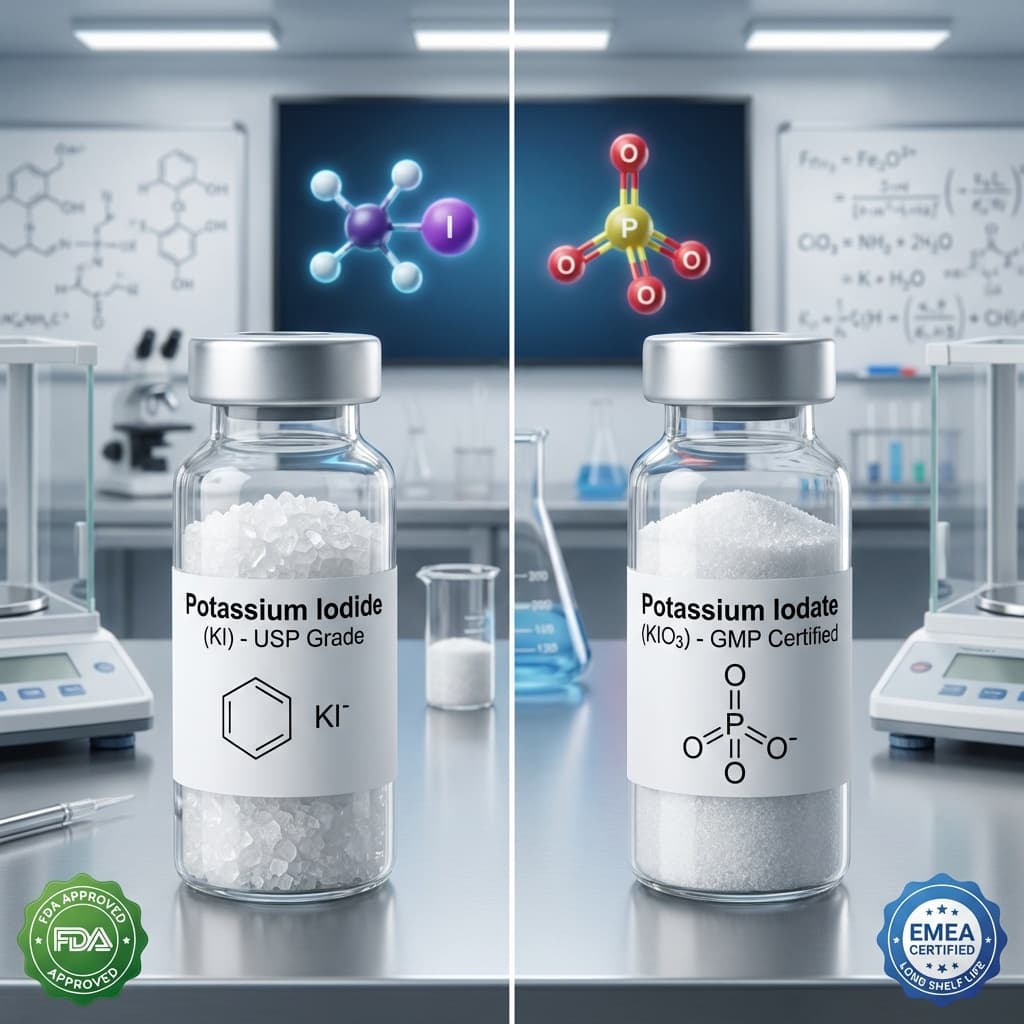
In nuclear and radiological emergency preparedness, thyroid blocking agents are the first line of pharmaceutical defense. Two compounds dominate global stockpiles: Potassium Iodide (KI) and Potassium Iodate (KIO₃).
Both protect the thyroid — but they differ significantly in stability, shelf life, regulatory status, and operational suitability. For institutional buyers, understanding these differences is not academic — it directly affects your preparedness strategy.
What Is Potassium Iodide (KI)?
Potassium Iodide is a stable salt of iodine (KI). It has been the WHO-recommended thyroid blocking agent since the Chernobyl disaster established the critical importance of rapid iodine prophylaxis. KI works by saturating the thyroid with stable iodine within 30–120 minutes of ingestion, preventing uptake of radioactive iodine-131.
Key Characteristics of KI
Bioavailability
High — absorbed within 30–120 min
Regulatory Status
FDA-approved, WHO Essential Medicine, USP/BP/IP
Available Forms
Tablets (65mg, 130mg), oral solution, powder
Shelf Life
5–7 years (cool, dry, light-protected)
Stability
Hygroscopic — requires moisture-proof packaging
Best Suited For
Temperate climates, hospital & clinical settings
What Is Potassium Iodate (KIO₃)?
Potassium Iodate (KIO₃) is an oxidized form of potassium iodine that serves the same thyroid-blocking function as KI. Its distinct chemical properties make it particularly relevant for tropical and humid climate stockpiling — widely used across Africa, Southeast Asia, the Middle East, and Latin America.
Key Characteristics of KIO₃
Bioavailability
Moderate — requires reduction to iodide before thyroid uptake
Regulatory Status
WHO-recognized for emergency use; accepted by many national pharmacopeias
Available Forms
Tablets (170mg equivalent), powder
Shelf Life
8–10+ years — superior to KI
Stability
Non-hygroscopic — highly stable in tropical conditions
Best Suited For
Tropical/humid climates, field distribution, austere conditions
Head-to-Head Comparison: KI vs KIO₃
| Parameter | Potassium Iodide (KI) | Potassium Iodate (KIO₃) |
|---|---|---|
| Chemical formula | KI | KIO₃ |
| WHO recommendation | Primary recommendation | Recognized alternative |
| FDA approval | ✓ Yes | ✗ No |
| Bioavailability | High (direct absorption) | Moderate (requires reduction) |
| Shelf life | 5–7 years | 8–10+ years |
| Humidity stability | Hygroscopic (moisture-sensitive) | Non-hygroscopic (stable) |
| Best suited for | Temperate climates, hospitals | Tropical/humid climates, field use |
| Onset of action | 30–120 minutes | 60–180 minutes |
| Pharmacopeia grades | USP, BP, IP | BP, IP (varies by region) |
| Cost per unit | Lower | Slightly higher (offset by shelf life) |
Which Should You Stockpile? A Decision Framework
The choice between KI and KIO₃ is not about which is "better" in absolute terms — it depends entirely on your operational context.
Choose KI if:
Choose KIO₃ if:
Consider Both if:
Procurement Considerations: 5 Questions to Ask Your Supplier
What pharmacopeia grade is offered?
Ensure USP, BP, or IP certification with batch-level documentation. Grade determines regulatory acceptance in your jurisdiction.
What is the validated shelf life?
Demand accelerated stability study data, not just manufacturer claims. Real-world storage conditions matter.
Can you supply both KI and KIO₃?
A supplier offering both gives you procurement flexibility to match the right compound to each deployment context.
What packaging is used?
Blister packs protect against moisture and are suited for humid climates. Bulk bottles may not be appropriate for tropical field use.
What is your emergency response lead time?
In a nuclear event, weeks matter. Pre-positioned stock and rapid deployment capability are essential — not optional.
Golden Hour Pharma: Your Single Source for Both KI and KIO₃
Golden Hour Pharma supplies both Potassium Iodide and Potassium Iodate in pharmaceutical grades (USP, BP, IP) with full batch documentation, stability data, and regulatory compliance support.
WHO-GMP Certified Manufacturing
Validated pharmaceutical-grade products from certified facilities
Dual Product Supply
Both KI and KIO₃ — flexible, single-point procurement
Flexible Packaging
Blister packs, bottles, and bulk options for all deployment contexts
Stability Documentation
Accelerated stability data and full batch records provided
Emergency Response Ready
Pre-positioned inventory with rapid deployment capability
30+ Country Supply Network
Trusted institutional supply across MENA, Africa and beyond
Golden Hour Pharma — Ready when it matters most.