
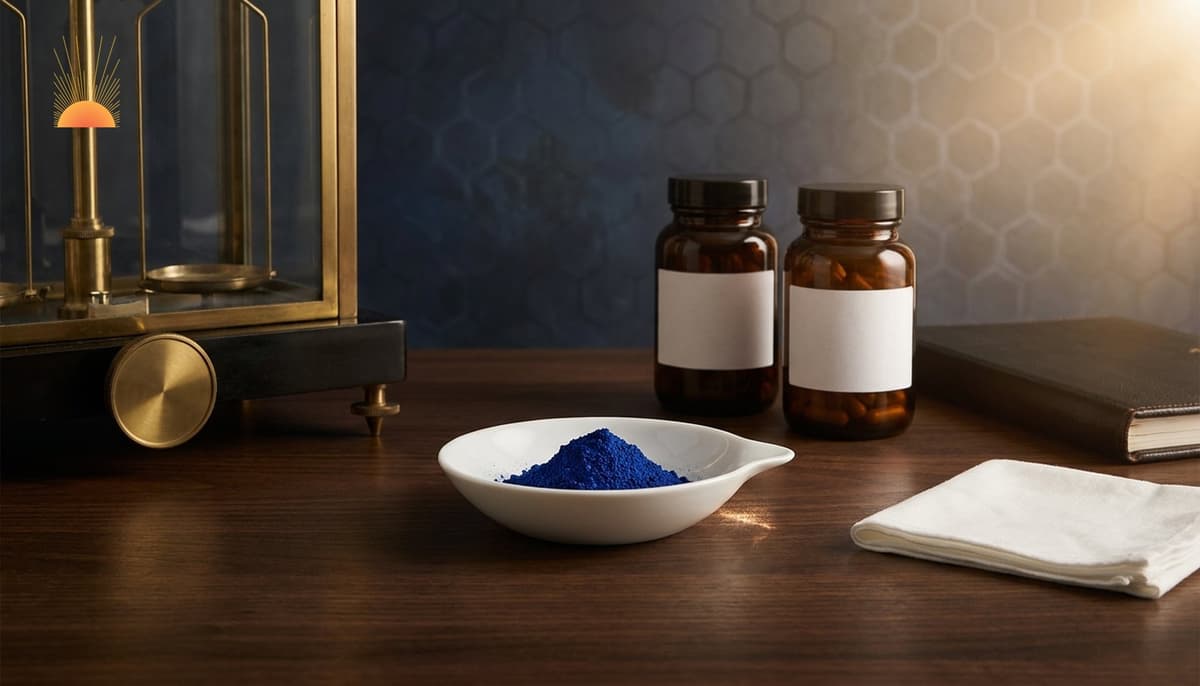
It sounds counterintuitive — a pigment used in eighteenth-century paints becoming a medical antidote. Yet the Prussian Blue antidote (ferric hexacyanoferrate, Fe4[Fe(CN)6]3) is exactly that: a coordination polymer engineered to capture radioactive cesium-137 and thallium ions inside the gut and remove them from the body before they can do harm.
FDA-approved in 2003 and listed on the WHO Model List of Essential Medicines, Prussian Blue is the only medical countermeasure approved for internal radiocesium and thallium contamination — and one of a handful of orphan drugs that every country is advised to stockpile in advance of any radiological incident.
How Prussian Blue Is Manufactured
Pharmaceutical-grade Prussian Blue is not the same substance as the industrial pigment, even though they share a similar chemical backbone.
Core Chemical Formation
The compound is synthesized by reacting:
- Ferric salts (such as ferric chloride)
- Ferrocyanide salts (such as potassium ferrocyanide)
This forms an insoluble coordination polymer:
- Ferric hexacyanoferrate lattice — Fe4[Fe(CN)6]3
The structure is not a simple salt — it is a three-dimensional coordination network with embedded ion-exchange channels.
Controlled Pharmaceutical Processing
To convert the raw lattice into a safe oral antidote, manufacturers follow strict steps:
- High-purity reagents — eliminates heavy-metal contamination at source
- Controlled precipitation — ensures uniform particle size
- Extensive washing — removes free cyanide traces
- Drying and micronization — increases surface area and adsorption kinetics
- GMP-grade purification and testing — validates safety for ingestion
The result is an insoluble, non-bioavailable microcrystalline particle designed to act only within the gastrointestinal lumen — not absorbed into the bloodstream.
Golden Hour Pharma manufactures pharmaceutical-grade Prussian Blue and ferric hexacyanoferrate to GMP standards for institutional and government stockpiles, with documented batch-level quality assurance.
Why a Pigment Works as an Antidote
The effectiveness of Prussian Blue as a radiation antidote is rooted in coordination chemistry and ion-exchange thermodynamics — not pharmacology in the traditional sense.
Key Scientific Principles
- It behaves as a selective cation-exchange resin
- The lattice contains Fe(CN)64− frameworks with interstitial cavities
- These cavities have size-selective binding affinity for monovalent ions
Mechanism of Action
When ingested, the compound:
- Remains chemically inert at gastric pH (no dissolution)
- Provides high-affinity binding sites for Cs+ and Tl+ ions
- Drives ion-exchange via diffusion-based equilibrium displacement of K+ or H3O+ ions held in the lattice
- Irreversibly traps bound ions inside the cage structure
- Prevents enterohepatic recycling — particularly important for cesium, which biliary-recirculates
- Eliminates trapped toxins via fecal excretion
The U.S. Radiation Emergency Medical Management (REMM) guidance and the CDC Radiation Emergencies programme both confirm this lumen-only mechanism — the active compound is not absorbed into the systemic circulation, which is also why side-effect profile is mild compared with conventional chelators.
Why Specifically Cesium and Thallium?
Both isotopes share three properties that make them ideal binding targets:
- They exist as monovalent cations (Cs+, Tl+)
- Their ionic radii are compatible with Prussian Blue's lattice cavities
- They mimic potassium in biological systems (K+ analogues), which is why both accumulate in living tissue
Scientific Basis for Selectivity
- Cs+ has a low hydration energy → enters the lattice with minimal energetic cost
- Tl+ has strong polarizability → forms stronger coordination interactions inside the cage
- The lattice shows preferential binding-energy stabilization for these ions over Na+ and K+, which is why physiological electrolytes are not stripped during treatment
Why This Matters Clinically
- Cesium recirculates through bile secretion; Prussian Blue interrupts this cycle by binding Cs+ in the gut before reabsorption
- Thallium accumulates in soft tissues and the central nervous system; lumenal binding accelerates fecal clearance
This is why Prussian Blue is the first-line antidote in:
- Radiological contamination involving cesium-137 (Cs-137 — the principal long-lived fission isotope released in reactor accidents and dirty-bomb scenarios)
- Heavy-metal poisoning involving thallium (industrial and intentional exposures)
Pharmaceutical Excipients and Formulation
Medical formulations are typically supplied as 0.5 g insoluble Prussian Blue capsules — never raw powder.
Standard Excipients
- Gelatin capsule shell — oral delivery vehicle
- Microcrystalline cellulose — improves compressibility and uniform dispersion
- Colloidal silicon dioxide — enhances flow properties and prevents agglomeration
- Magnesium stearate — lubricant during capsule filling
Formulation Engineering
- Electrolyte balance is indirectly considered to maintain GI ion-exchange efficiency
- Particle engineering ensures maximum surface-area-to-volume ratio for adsorption kinetics
Pigment vs Pharmaceutical-Grade — A Critical Difference
Industrial pigment and pharmaceutical Prussian Blue differ significantly. The distinction is not cosmetic — it determines whether the substance is safe to ingest.
| Attribute | Industrial Pigment | Pharmaceutical Grade |
|---|---|---|
| Synthesis control | Variable stoichiometry | Stoichiometrically controlled |
| Purity | Variable; trace metals possible | Validated; trace contaminants below pharmacopeial limits |
| Particle size | Uncontrolled distribution | Engineered microcrystalline morphology |
| Cyanide residuals | Not specified | Removed via extensive washing and validated |
| Manufacturing standard | Industrial | GMP-validated, full toxicology dossier |
| Approved for ingestion | No | Yes (FDA, 2003) |
Only the pharmaceutical form is approved for medical use because it ensures non-toxicity, non-absorption, and predictable ion-exchange capacity.
Clinical Evidence — Goiânia 1987 and Beyond
The most documented use of Prussian Blue in a real-world radiological incident is the 1987 Goiânia accident, in which an unsecured radiotherapy source containing cesium-137 was opened by scrap dealers in Brazil. About 112,000 people were screened; 249 were confirmed contaminated; four died within four weeks.
Of the contaminated patients, 46 received Prussian Blue therapy as documented in the IAEA's official Goiânia report.
71%
average reduction in absorbed radiation dose among Goiânia patients treated with Prussian Blue
110 → 30 days
biological half-life of cesium reduced by Prussian Blue therapy
8 → 3 days
biological half-life of thallium reduced by Prussian Blue therapy
FDA 2003
year Prussian Blue was approved as the only medical countermeasure for internal Cs and Tl contamination
Subsequent cases — including occupational thallium exposures and radiological forensics work — have replicated these decorporation outcomes, making Prussian Blue one of the few radiological countermeasures with both regulatory approval and field-proven efficacy.
FDA Approval, Dosing, and Treatment Duration
The FDA approved insoluble Prussian Blue (active ingredient: ferric hexacyanoferrate) in October 2003 as the first medical countermeasure for internal radiocesium and thallium contamination. The product is supplied as 0.5 g (500 mg) gelatin capsules for oral administration.
Standard Dosing
Across FDA labelling and CDC guidance, the typical course ranges from 3 g to 9 g daily, depending on the level of exposure — as confirmed by healthcare professionals and per established treatment guidelines.
- Lower end of the range applies to lighter contamination and to paediatric patients
- Higher end applies to confirmed adult contamination cases
- Treatment is supplied as 0.5 g insoluble Prussian Blue capsules taken orally three times daily
- Treatment duration is a minimum of 30 days, extended for as long as bioassay shows elevated body burden of cesium or thallium
Dosing must be confirmed and supervised by a treating physician with access to bioassay. Pharmaceutical-grade Prussian Blue is a prescription medicine and should never be self-administered.
Strategic Importance in Emergency Medicine
Prussian Blue is a cornerstone of:
- Nuclear and radiological emergency stockpiles
- Civil-defence preparedness systems
- Hospital toxicology and emergency-department protocols
The reasons are operational, not theoretical:
Highly selective
Ion-specific binding for Cs+ and Tl+ — does not strip physiological potassium or sodium.
Chemically stable
Inert across the full GI pH range. Long shelf life under standard pharmaceutical storage.
Non-systemic
No bloodstream interaction. Mild side-effect profile: mainly constipation, blue-coloured stools, occasional GI upset.
Effective even after delay
Useful for patients identified hours or days after exposure — interrupts ongoing biliary recycling at any point in the contamination timeline.
Because it is an orphan drug with only two to three pharmaceutical-grade manufacturers worldwide, advance procurement is the only realistic stockpile strategy. Waiting until an event begins is operationally too late — global supply mobilization typically takes weeks, not hours.
Frequently Asked Questions
How does Prussian Blue work as a radiation antidote?
It traps radioactive cesium and thallium ions inside its crystalline lattice through ion-exchange, then carries them out of the body via fecal elimination. The compound is not absorbed — it works entirely in the gut.
Is Prussian Blue safe to swallow?
Pharmaceutical-grade Prussian Blue is safe and FDA-approved for oral use. It is non-bioavailable, meaning it does not enter the bloodstream. Common side effects are limited to constipation, blue stools, and occasional gastrointestinal discomfort. Industrial pigment is not safe to ingest.
How long does Prussian Blue treatment last?
The standard treatment course is at least 30 days. Therapy continues until bioassay (urine or whole-body counting) shows the body burden of cesium or thallium has fallen to acceptable levels.
Why is Prussian Blue effective against cesium-137?
Cesium-137 is a monovalent cation (Cs+) that mimics potassium in the body and recirculates through bile. Prussian Blue's lattice is specifically sized to trap Cs+ and prevent reabsorption from the intestine. Field data from the 1987 Goiânia accident showed an average 71% reduction in absorbed dose for treated patients.
What is the difference between pigment and pharmaceutical Prussian Blue?
Pharmaceutical-grade is synthesized under controlled stoichiometry, purified to remove free cyanide and trace metals, micronized to a defined particle size, and manufactured under GMP conditions. Industrial pigment lacks all of these controls and must never be used medically.
Bottom Line
A pigment becomes an antidote because of coordination chemistry, lattice selectivity, and ion-exchange thermodynamics — not because of medicinal origin.
Prussian Blue's crystal framework enables:
- Selective binding of toxic monovalent ions
- Disruption of biological recirculation pathways
- Permanent sequestration and fecal elimination of radiocesium and thallium
In high-risk environments, it is not just a drug — it is a designed chemical containment system for internal radioactive and heavy-metal decontamination. With the FDA approval, WHO Essential Medicines listing, and field-proven efficacy from Goiânia and beyond, it is the only molecular tool in this category.