
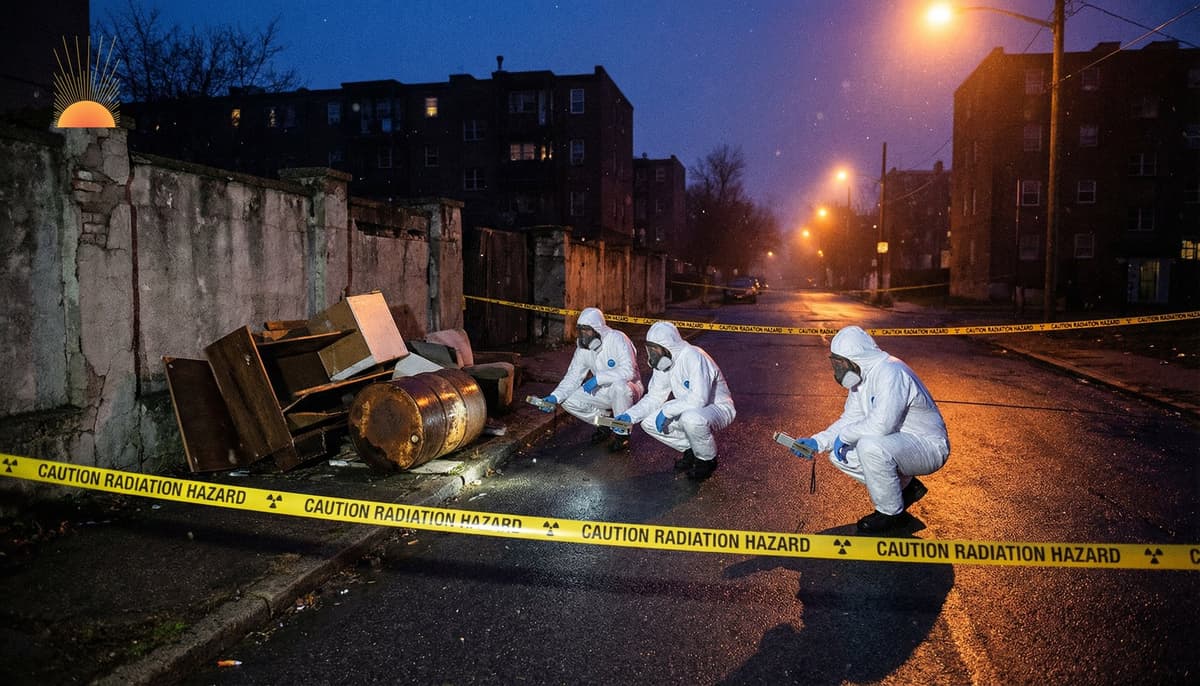
In 1987, a single abandoned medical device in Goiânia, Brazil triggered one of the worst radiological accidents in recorded history — not through an explosion, not through a reactor failure, but through ignorance, delay, and the absence of a preparedness system. The incident contaminated 249 people, killed four, displaced entire neighbourhoods, and generated 3,500 cubic metres of radioactive waste. Decades later, its lessons remain the clearest warning the world has received about what happens when radiological preparedness is treated as optional.
How the Incident Started: An Abandoned Radiotherapy Device
In September 1987, two scrap metal collectors entered an abandoned radiotherapy clinic in Goiânia, the capital of the Brazilian state of Goiás. The clinic had relocated months earlier, leaving behind a teletherapy unit — a medical device used for cancer treatment — that contained a caesium-137 sealed source capsule. The facility was unsecured. There were no locks, no warnings, and no regulatory follow-up to confirm the device had been safely decommissioned.
The collectors dismantled the device, removed the shielding, and extracted the caesium chloride capsule. What they found fascinated them: a glowing blue powder that shimmered in the dark, caused by Cherenkov radiation. Over the following days, the capsule and its contents were passed between family members, friends, and neighbours. Children played with the powder. It was smeared on skin. Some took it home as a curiosity.
This was the first contamination wave — and it happened entirely without any awareness that the material was radioactive.
How Contamination Spread Through the City
The distribution of caesium-137 through the community followed a pattern that emergency planners now study as a textbook case of uncontrolled radiological spread. The material moved through:
- Direct skin and hand contact with the powder
- Contaminated clothing worn in households
- Food preparation in contaminated kitchens
- Children ingesting particles through hand-to-mouth contact
- Secondary spread when contaminated individuals visited other homes
According to the IAEA's official report on the Goiânia accident, by the time the contamination was identified, the source material had been distributed across multiple households in separate parts of the city. Radiation was spreading silently — invisibly — with no mechanism to detect it and no system to contain it.
The Cost of Delayed Diagnosis
This delay is arguably the most critical failure of the entire incident. People began developing acute symptoms — burns on the skin, nausea, vomiting, severe weakness, and hair loss — within the first week. These individuals sought medical care. Hospitals treated them for suspected infections and allergic reactions. No one considered radiation exposure.
It took approximately 10 to 14 days from initial exposure before a medical physicist, using a portable radiation detector, identified extremely high gamma radiation levels inside one of the contaminated homes. That identification triggered an immediate national emergency response — military involvement, area evacuation, and the rapid escalation that should have begun nearly two weeks earlier.
In acute radiation syndrome, the severity of outcomes is directly tied to dose received and the speed of intervention. Every day of delay without Prussian Blue treatment — the indicated pharmaceutical countermeasure for caesium-137 internal contamination — allowed further isotope distribution throughout the body. The 10–14 day diagnostic window was not a logistical delay. It was a direct amplifier of harm.
Emergency Response and Mass Screening
Once radiation was confirmed, Brazilian authorities moved quickly. Emergency zones were declared, entire neighbourhoods were evacuated, and temporary screening centres were established in stadiums, schools, and public buildings across the city. The response involved the national military, federal health agencies, and international technical assistance from the IAEA.
Decontamination operations involved the demolition of houses, the removal of metres of contaminated topsoil, the destruction of clothing and household items, and the controlled burial of over 3,500 cubic metres of radioactive waste at a secure licensed site outside the city.
Health Impact and the Pharmaceutical Response
Of the 249 confirmed cases, more than 20 developed acute radiation syndrome (ARS) — a systemic response to high radiation doses affecting the haematopoietic, gastrointestinal, and central nervous systems. Four patients died. The four who died had received the highest doses and had also ingested caesium-137, leading to severe internal contamination that proved irreversible despite aggressive medical intervention.
Treatment protocols included:
- Supportive care: IV fluids, antibiotics to address infection vulnerability from immune suppression, blood transfusions, nutritional support
- Haematopoietic support: Bone marrow support in the most severely affected patients
- Prussian Blue (ferric hexacyanoferrate): Used in 46 patients to accelerate the elimination of internally absorbed caesium-137
The use of Prussian Blue in the Goiânia response is now a landmark data point in radiological medicine. At the time, the pharmaceutical was not yet universally approved — it was deployed under compassionate use protocols. A subsequent peer-reviewed study published in Health Physics documented that Prussian Blue reduced the biological half-life of caesium from approximately 110 days to 30 days — a 71% average reduction in absorbed radiation dose for treated patients. It received formal regulatory approval in multiple jurisdictions in the years following the incident.
Treatment Context: Prussian Blue does not reverse radiation damage already sustained. It eliminates caesium-137 from the body more rapidly, reducing the total absorbed dose. Early administration is critical — the sooner treatment begins after confirmed internal contamination, the lower the total dose the patient receives. Delayed diagnosis directly prevented early treatment in Goiânia.
Economic Cost: The Full Financial Reckoning
The economic damage from the Goiânia incident is often underappreciated in public accounts. The direct and indirect costs were substantial — and by 2026 values, represent a burden that runs well into the billions.
| Cost Category | Description | Estimated Value (1987) |
|---|---|---|
| Direct Cleanup | Demolition, soil removal, waste disposal, decontamination operations | ~USD 20 million |
| Healthcare System | Emergency screening of 112,000+, hospital mobilisation, treatment, long-term monitoring | Tens of millions USD |
| Indirect Economic Loss | Business closures, property destruction, relocation costs, productivity loss, regional trade impact, psychological harm | Hundreds of millions USD |
| 2026 Equivalent Burden | Adjusted for inflation and systemic impact scaling | ~USD 600M to 1.5B+ |
This is a critical point for procurement planners and government officials: Goiânia was not a nuclear explosion. It was a single orphaned medical source. There was no infrastructure destruction, no multi-city fallout, no power grid failure. A genuine nuclear event — or a radiological dispersal device detonated in a densely populated urban area — would multiply these figures by orders of magnitude.
Why the Impact Was So High: A Systems Failure
The severity of Goiânia's consequences was not inevitable. It was the product of compounding system failures, each of which made the next one worse:
No radiation monitoring infrastructure existed in the affected areas. The contamination spread for nearly two weeks before a single individual with a portable detector identified the source.
Prussian Blue — the indicated countermeasure for caesium-137 internal contamination — was not stockpiled in Brazil at any national or regional level. Its use was improvised under emergency conditions.
Physicians who treated the early cases did not consider radiation as a differential diagnosis. The symptoms — burns, nausea, weakness — were misattributed to infection. This cost two critical weeks of treatment time.
The abandoned radiotherapy unit had not been tracked by any regulatory authority after the clinic relocated. A functioning radioactive source inventory and disposal protocol would have prevented the source from becoming accessible.
WHO and IAEA: The Global Warnings That Followed
The Goiânia incident prompted a fundamental reassessment of radiological preparedness standards at the international level. The World Health Organization has since updated its critical medicines list for radiation and nuclear emergencies, explicitly identifying the medicines — including Prussian Blue and potassium iodide — that national health systems must have available before an emergency occurs.
The International Atomic Energy Agency has consistently reinforced this message in its safety standards and technical guidance. Its guidance on medical preparedness and response for nuclear or radiological emergencies outlines the systems, stockpiles, and training frameworks that member states are expected to maintain.
The core message from both organisations is consistent: radiological events are low probability but extremely high consequence. Preparedness is not a reaction to threat — it is a standing requirement for any government that accepts responsibility for public health.
Modern Countermeasures: What Is Now Available
The medical community's response capability today is substantially better than it was in 1987 — but only in countries that have invested in it:
Now formally approved in multiple regulatory jurisdictions for internal contamination with caesium-137 and thallium. Requires institutional pre-procurement to be available at the time of need. View procurement details.
Protects the thyroid gland from radioactive iodine (I-131) in nuclear or radiological events. Distinct from Prussian Blue — different threat, different mechanism. Both must be stockpiled. View KI supply options.
Portable gamma detectors, environmental monitoring networks, and personal dosimetry equipment have all improved significantly. Early detection compresses the response window and limits exposure for both patients and responders.
WHO and IAEA frameworks now provide detailed guidance on triage, contamination control, pharmaceutical deployment, and inter-agency coordination during radiological events. Adoption, however, remains uneven across regions.
These countermeasures exist. They are available. But they must be procured, stockpiled, and ready before an incident — not sourced under emergency conditions when supply chains are under pressure and pricing spikes.
The Real-World Procurement Gap
The most dangerous assumption any government or institution can make about radiological preparedness is that medicines can be sourced quickly once an event occurs. The Goiânia experience — and every major radiological incident since — demonstrates the opposite.
During radiological or nuclear emergencies, procurement systems face simultaneous pressure:
- Supply chain disruption as regional logistics break down
- Price escalation as panic procurement drives up costs
- Import delays as export restrictions are imposed by source countries
- Quality assurance failures as demand outstrips compliant supply
Governments that have not established pre-positioned pharmaceutical stockpiles — through reliable, WHO-GMP aligned suppliers with verified emergency logistics capability — are exposed in exactly the way Goiânia was exposed: without the means to respond when response becomes urgent.
The institutional emergency preparedness framework and the availability of nuclear emergency antidote supply must be established before a crisis, not during one. The cost of that preparation is a fraction of the economic burden documented above.
The Preparedness Imperative: What Goiânia Proved
The Goiânia disaster is not a historical curiosity. It is a documented proof of what happens when preparedness systems are absent — and a precise blueprint for how to build them correctly.
A radiological event does not require a nuclear weapon, a reactor meltdown, or a military conflict. A single orphaned medical source, improperly decommissioned, improperly secured, and improperly identified by the healthcare system, killed four people, hospitalised dozens, displaced an entire neighbourhood, and cost hundreds of millions of dollars.
The difference between the Goiânia outcome and a controlled, limited-casualty response is not luck or geography. It is the presence of trained clinicians who recognise radiation exposure, detection systems that identify contamination early, pharmaceutical stockpiles that are pre-positioned and ready, and supply partners capable of delivering under crisis conditions — reliably, at committed pricing, without delay.
Those are the components of genuine radiological preparedness. And they must be in place before the next event occurs — not built in response to one.
- A readiness partner — pre-positioned antidote supply aligned with WHO and IAEA frameworks
- A supply reliability force — stable pricing and emergency-ready logistics when others face delays and price spikes
- A healthcare protection system enabler — 750+ products, WHO-GMP compliant, present in 30+ countries
We are not just a company — we are a force. Ready when it matters most.