
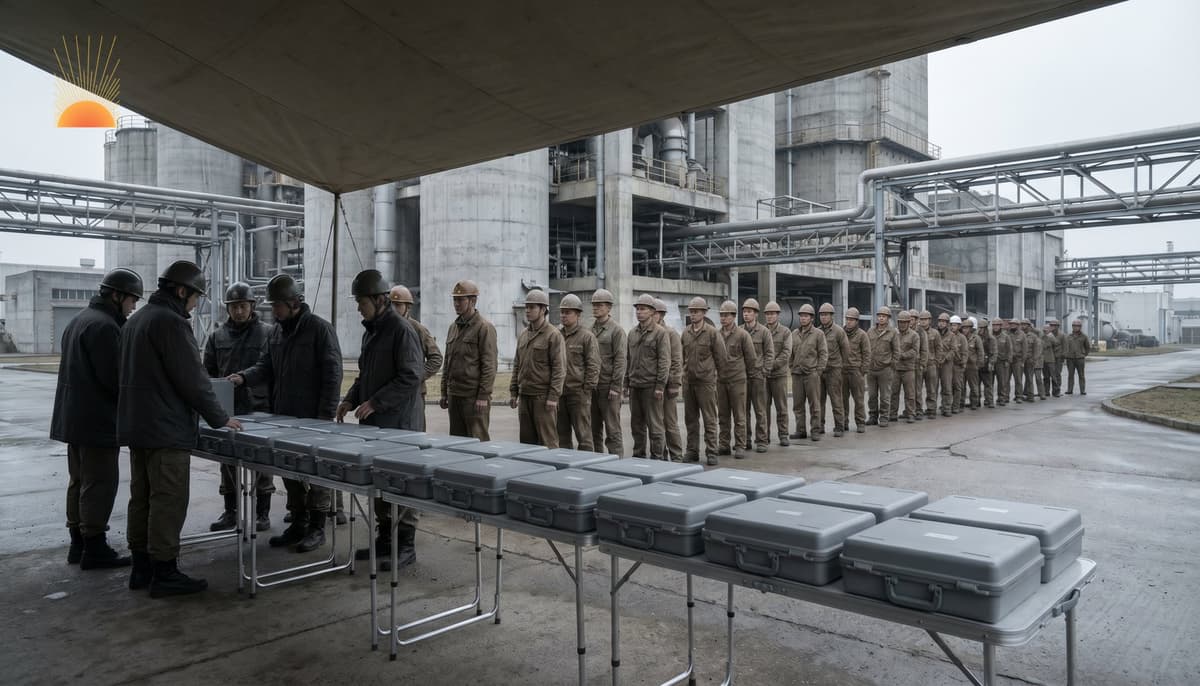
In a large-scale nuclear, radiological, or toxic contamination emergency, the real disaster is not only the hazardous exposure—it is the collapse of normal systems that society depends on every day.
What begins as a localized incident rapidly transforms into a multi-layered national disruption affecting psychology, infrastructure, logistics, and healthcare simultaneously.
1. The Human Reaction: Anxiety Becomes a Secondary Disaster
Before official alerts even stabilize, human behavior becomes unpredictable:
- Panic buying empties food and water supplies within hours
- Roads become blocked by mass movement of civilians
- Families split during evacuation chaos
- Social media amplifies fear faster than official communication
This is not disorder—it is untrained survival behavior under uncertainty.
Without civilian training, panic itself becomes a multiplier of the crisis.
This is where preparedness training changes the curve—turning fear response into structured action response.
2. Electricity, Networks & Communication Breakdown
Modern societies depend on uninterrupted connectivity.
In a high-impact emergency:
- Power grids may be partially disrupted or load-shedded
- Mobile networks become congested or fail under overload
- Internet services slow or collapse regionally
- Emergency communication channels are overwhelmed
Prepared systems require offline protocols, manual decision pathways, and pre-trained local response units—not only digital dependency.
3. Civil Defense Limitations: Scale vs Reality
Even the strongest civil defense systems face structural limits:
- Limited manpower relative to population density
- Delayed reach to multiple simultaneous hotspots
- Prioritization protocols that leave secondary zones unsupported initially
- Logistical delays in deploying specialized teams
In small countries, this becomes more critical—because:
there is no "deep interior buffer zone" to absorb impact.
This is why civilian readiness is not optional—it is load-sharing for national response systems.
4. Healthcare System Overload: The Invisible Collapse
Hospitals do not fail suddenly—they saturate.
What actually happens:
- Emergency departments exceed capacity within hours
- ICU beds become scarce immediately
- Elective care is suspended
- Staff fatigue and resource shortage begin within the first operational cycle
- Temporary facilities must be created under pressure
But here is the critical issue:
Even when extra beds are arranged, the delay itself costs lives.
Because exposure and contamination do not wait for infrastructure scaling.
This is where distributed first-response kits become the first stabilizing layer before hospital systems take over.
5. Transportation Chaos: Air, Sea, and Land Restrictions
In severe incidents:
- Airspace may be restricted or completely closed
- Flight routes diverted or suspended
- Sea ports undergo inspection bottlenecks and clearance delays
- Cargo movement slows due to contamination screening protocols
- Road checkpoints multiply, creating logistical gridlock
What appears as "control measures" on paper translates into:
delayed medical supplies, delayed evacuation, delayed response.
In many cases, external aid becomes slower than internal survival needs.
6. The Most Underestimated Risk: Time Density
In such events, time is not linear—it is compressed.
Every delay multiplies consequences:
- 1 hour delay in antidote administration reduces effectiveness
- 1 hour delay in evacuation increases exposure risk
- 1 hour delay in communication amplifies misinformation
- 1 hour delay in medical triage increases mortality probability
7. Where Antidotes Become Strategic Infrastructure
In radiological emergencies, medical countermeasures are not "hospital-only resources".
They become first-contact survival tools:
- Potassium Iodide (KI):
Protects thyroid uptake of radioactive iodine when taken early—before exposure saturates biological pathways. - Prussian Blue (Ferric Hexacyanoferrate):
Binds radioactive cesium and thallium internally, reducing systemic retention and promoting excretion.
But real-world application is not just pharmacology—it is timing, access, and trained usage.
8. The Limitation of Prussian Blue and Why Support Systems Matter
Prussian Blue, while life-saving, can introduce:
- Constipation and gastrointestinal discomfort
- Reduced absorption of certain nutrients or medications
- Additional physiological burden in stressed individuals
This becomes critical in frontline responders operating under sustained pressure.
This is why supportive protocols, including magnesium-based stabilization frameworks, help maintain:
- Electrolyte balance
- Neuromuscular stability
- Physiological resilience under operational stress
Not as a replacement, but as a support layer for responder endurance in prolonged emergency environments.
9. Why Civilian Training Is the Real Force Multiplier
No system scales fast enough during crisis unless civilians are trained to act correctly.
Training changes outcomes by:
- Reducing panic behavior
- Enabling correct early antidote use
- Preventing exposure amplification
- Supporting first-response before official arrival
- Stabilizing local environments until system recovery
A trained civilian population becomes a distributed response network instead of a passive vulnerable mass.
This is where preparedness becomes national resilience infrastructure—not awareness alone.
10. Why Distributed Kits Change the Entire Model
If emergency antidote kits exist only in hospitals, the system is always delayed.
If they exist in:
- Homes
- Offices
- Industries
- First responder units
Then response becomes instantaneous and decentralized.
This changes the entire crisis curve—from uncontrolled escalation to managed containment.
Golden Hour Pharma: Building Response Where Time Matters Most
GOLDEN HOUR PHARMA focuses on emergency antidote readiness systems designed for real-world collapse conditions—not controlled environments.
This includes:
- Emergency Antidote Systems:
Potassium Iodide protocols, Prussian Blue deployment frameworks, and structured responder support approaches - Civilian Training Programs:
Practical, scenario-based preparedness training enabling correct action under panic conditions - Emergency Response Manuals:
Step-by-step operational guidance for radiological, toxic, and chemical incidents designed for real-time decision making - Responsive Emergency Kits:
Distributed across homes, workplaces, industries, and frontline units to eliminate response delay - Frontline Responder Protocol Systems:
Structured operational frameworks supporting civil defense, rescue teams, and emergency medical responders under high-load conditions
And integrated magnesium-supported responder care frameworks to support physiological stability under prolonged operational stress conditions in emergency deployments.
The Core Truth
Every life is not just a statistic—it is a future, a family, and a national strength.
Preparedness is not reaction.
It is civilization designed to survive uncertainty.
We are not just a company… we are a force.
And we prepare civilians and responders to become a force for their nations.