
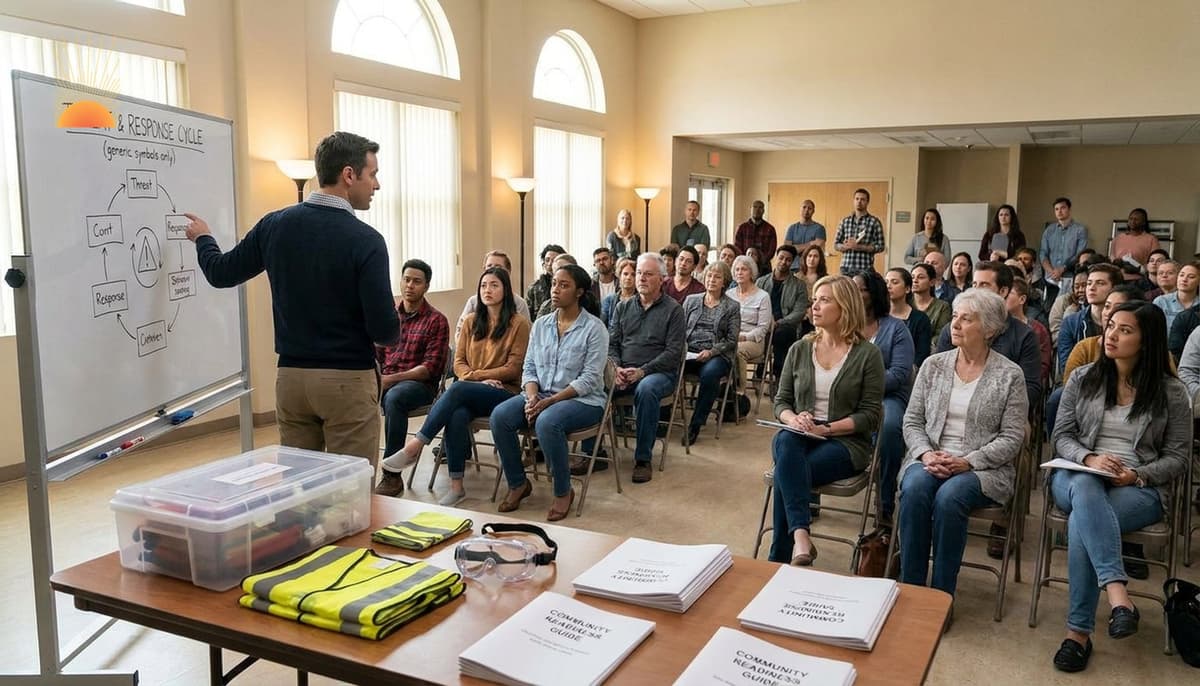
In every nation, there is a system.
We train pilots to fly aircraft with precision. We train doctors to save lives under pressure. We train soldiers to defend borders. We train police to maintain order. We train firefighters to respond to danger.
Every critical function in society is supported by structured training, discipline, and readiness.
Yet there is one group that is present in every emergency, every disaster, every crisis scenario—and remains largely untrained.
The civilian.
The Missing Link in National Preparedness
Governments invest heavily in:
- Defense infrastructure
- Healthcare systems
- Emergency response forces
- Disaster management frameworks
These are essential. They save lives.
But there is a critical reality that is often overlooked:
Emergency response does not begin when professionals arrive. It begins the moment the event occurs.
And in that moment—before sirens, before coordination, before external help—it is the civilian who is exposed, affected, and forced to act.
The First 10–30 Minutes: Where Outcomes Are Decided
Whether it is:
- A radiation leak
- A toxic gas release
- A fast-moving fire
- A sudden earthquake
- A pandemic outbreak
The first minutes are decisive.
During this window:
- Exposure happens
- Panic spreads
- Decisions are made—right or wrong
And yet, most civilians:
- Do not know whether to stay or evacuate
- Do not know how to reduce exposure
- Do not know how to protect their families
- Do not know how to use even basic emergency resources
This is not a failure of individuals. It is a gap in the system.
Emergencies Are Not Single-Domain Events
Preparedness cannot be limited to one type of threat.
Modern risks are interconnected and unpredictable:
- Nuclear and radiological incidents
- Chemical and industrial leaks
- Biological threats and pandemics
- Natural disasters—floods, fires, earthquakes
Emergencies do not arrive labeled.
And response cannot be dependent on a single force or sector.
A Critical Question Every Nation Must Ask
In the first critical minutes of a crisis—are citizens part of the solution, or part of the problem?
This is not a question of blame. It is a question of preparedness.
The Case for Civilian Response Training (CRT)
If societies can train individuals to:
- Drive vehicles
- Operate machinery
- Perform specialized professions
Then why is there no universal, structured approach to teaching people how to:
- Respond to emergencies
- Make rapid, informed decisions
- Protect themselves and others
This is where Civilian Response Training (CRT) becomes essential.
CRT is not about turning civilians into professionals. It is about giving them:
- Awareness
- Decision-making ability
- Basic response skills
So that in the absence of immediate help, they can act—not freeze.
From Passive Presence to Active Capability
An untrained civilian in a crisis is vulnerable.
A trained civilian becomes:
- A stabilizing force within the family
- A support system within the community
- A bridge until professional help arrives
This shift—from passive presence to active capability—is what defines a resilient society.
Preparedness Begins at Home
Most emergencies affect people where they live.
Yet very few households are prepared to:
- Create a safe internal environment
- Control exposure to external threats
- Manage short-term survival without assistance
Preparedness at the civilian level is not complex. But it must be:
- Structured
- Practical
- Rehearsed
Time Is the Most Critical Factor
In any emergency, time determines outcome.
- The sooner exposure is reduced, the better the survival rate
- The faster the response, the lower the long-term impact
- The earlier the intervention, the greater the recovery potential
This is the principle that defines effective emergency response:
The first actions matter more than delayed expertise.
In high-risk scenarios such as radiation or toxic exposure, access to the right medical countermeasures, antidotes, and protective systems within this critical window can significantly influence outcomes.
Bridging the Gap: The Role of GOLDEN HOUR PHARMA
Closing the gap between exposure and response requires more than awareness—it requires integrated capability.
GOLDEN HOUR PHARMA is a WHO-certified pharmaceutical manufacturer with a portfolio of more than 750 products across sterile and non-sterile categories, including:
- Tablets
- Capsules
- Injectables
- Syrups
- Ointments
- Eye and ear drops
The organization specializes in:
- Emergency antidotes
- Radiation countermeasures
- Oncology and autoimmune therapies
With a presence across more than 30 countries and strong regional partnerships in Saudi Arabia, UAE, and Bahrain, GOLDEN HOUR PHARMA operates not only as a manufacturer—but as a preparedness partner.
Its approach extends beyond pharmaceuticals into a complete civilian readiness ecosystem that includes:
- Emergency medical kits designed for real-world crisis scenarios
- Structured civilian training programs (CRT) focused on decision-making and response
- Preparedness manuals and operational guides for households, institutions, and governments
- Technical expertise and advisory support for emergency planning and response systems
A key differentiator is the focus on time-critical intervention—ensuring that essential medicines, antidotes, and response systems are accessible within the golden hour, when outcomes can still be changed.
By combining:
- Medical science
- Training frameworks
- Practical deployment systems
GOLDEN HOUR PHARMA enables civilians and institutions to move from awareness to action.
A New Perspective on National Readiness
A nation cannot rely solely on its systems, no matter how advanced.
True preparedness exists when:
- Systems are ready
- Institutions are equipped
- And citizens are capable
Because in reality:
The first response is always civilian. The outcome depends on how prepared that civilian is.
Conclusion
Preparedness is not fear-driven. It is responsibility-driven.
It is not about expecting disasters. It is about being ready when they occur.
A nation is not truly prepared when only its forces are ready.
It is prepared when its people are.