
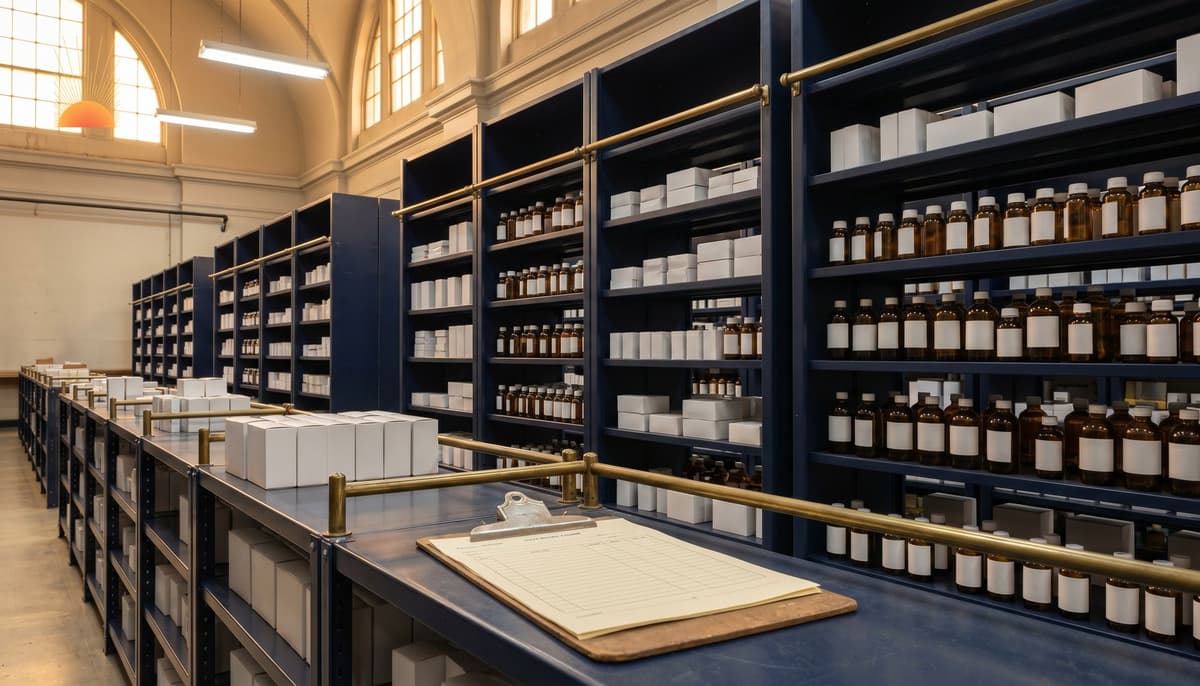
The World Health Organization's 2023 review of national radiation emergency preparedness reached a stark conclusion: "Preparedness for radiation emergencies is consistently reported as the weakest area of preparedness in many countries." For health ministries and civil defence procurement teams, the gap is not awareness — it is the stockpile.
What the WHO 2023 Stockpile Guidance Actually Recommends
In January 2023, the World Health Organization published National stockpiles for radiological and nuclear emergencies: policy advice — the first formal update to its recommended medicine list since 2007. The publication consolidates more than a decade of clinical, regulatory, and operational experience into a four-category stockpile framework that every national procurement team should be able to map their inventory against.
A national radiation emergency stockpile, in WHO's framing, is not a single drug or a single supplier — it is four functionally distinct categories of medicines, each addressing a different mechanism of radiological injury.
Blocks the thyroid from absorbing radioactive iodine after a nuclear release. Most cost-effective preventive countermeasure in the entire stockpile.
Remove radionuclides already inside the body — Prussian Blue for caesium and thallium, calcium- and zinc-DTPA for plutonium, americium, and curium.
Mitigate bone-marrow damage in Acute Radiation Syndrome (ARS), supporting recovery of white blood cell production after high-dose exposure.
Anti-emetics, anti-diarrheals, antibiotics, and supportive medicines for the secondary clinical effects that overwhelm hospitals in the days after exposure.
A stockpile that is strong in one category and weak in another is not a stockpile — it is a partial answer to a multi-stage emergency. Procurement teams should evaluate readiness category by category.
Category 1: Stable Iodine — The First Hour Decision
When a nuclear or radiological release puts radioactive iodine (I-131) into the air, the thyroid gland will absorb it within hours. Once absorbed, it cannot be removed. Stable iodine — given before or within the first few hours of exposure — saturates the thyroid so the radioactive form has no binding sites left to occupy.
This is the single most cost-effective preventive medicine in the radiation pharmacopoeia. The cost per protected citizen is measured in cents. The cost of failing to administer it is measured in decades of thyroid cancer cases — as the Chernobyl experience documented across Belarus, Ukraine, and Russia.
Two formulations matter for national stockpiles:
The form most widely recognized in WHO and CDC dosing guidance. Validated against the WHO four-tier dosage table — 16 mg neonatal, 32 mg infant, 65 mg paediatric, 130 mg adult. Institutional supply is offered across the 32 mg, 65 mg, and 130 mg paediatric and adult strengths.
More chemically stable than KI under tropical heat and humidity. Preferred by several MENA and African civil defence stockpiles for long-term storage. Dose-equivalent to KI when correctly formulated.
Most national stockpiles hold a combination of both forms. The procurement question is rarely "KI or KIO3" — it is "do we have enough of each, in the strengths the WHO dosage table actually requires, with shelf life that matches our rotation cycle?"
Category 2: Decorporation Agents — Removing What Already Got In
Decorporation is the clinical term for removing internalised radionuclides from the body before they cause sustained cellular damage. This is the category most procurement teams underestimate, because it is the category where supply is genuinely limited globally.
Binds radioactive caesium-137 and thallium in the gastrointestinal tract and accelerates elimination. The reference treatment for the type of fallout most associated with reactor accidents and radiological dispersal devices. WHO-listed for this indication; FDA-approved as a drug class for caesium and thallium decorporation.
Chelating agents used to treat internal contamination with transuranic radionuclides — plutonium, americium, curium. Critical for industrial nuclear accidents and certain weapons-related exposures. Stockpile depth here is a national-level decision tied to threat assessment.
For caesium and thallium contamination — by far the most likely radionuclides in any non-weapons radiological event — Prussian Blue is the entire answer. Stockpile sizing should reflect not the headline scenario, but the population at risk in the relevant exclusion radius around nuclear facilities, transit corridors, and population centres.
Category 3 and 4: Cytokines and Symptomatic Care
The third WHO category — cytokines such as filgrastim and pegfilgrastim — addresses the bone-marrow suppression that defines high-dose Acute Radiation Syndrome (ARS). Recovery of neutrophil and platelet counts is what determines survival in the 30 days after a serious whole-body exposure. These are biologics with cold-chain requirements and short shelf lives, which makes their procurement and rotation a specialised exercise.
The fourth category — symptomatic care — is where many stockpile audits fall short. Acute radiation exposure causes severe vomiting, diarrhoea, dehydration, and immune suppression. Hospital pharmacies in a mass-casualty radiological event will exhaust their working stocks of anti-emetics (ondansetron, metoclopramide), oral rehydration solutions, broad-spectrum antibiotics, and basic infection-control medicines within days.
WHO's guidance is unambiguous: a radiation emergency stockpile that holds antidotes but not symptomatic-care medicines is incomplete. A useful procurement audit asks whether the symptomatic layer is sized to the same population-exposure scenario as the antidote layer.
How to Size a National Stockpile
WHO and the IAEA both decline to publish a single per-capita formula for national stockpile sizing — for a defensible reason. The right number depends on threat assessment, exclusion zone size, population density in the at-risk zone, and the country's distribution architecture for moving medicines from central to district storage during an emergency.
That said, a working framework procurement teams find useful:
| Stockpile Layer | Population Coverage | Procurement Anchor |
|---|---|---|
| Stable iodine | 100% of population within evacuation/shelter radius | WHO four-tier dosage table by age |
| Prussian Blue | 5–10% of at-risk population (course of treatment, 21 days) | Full course per affected adult, paediatric subset |
| Ca/Zn-DTPA | Threat-specific (industrial / weapons exposure scenarios) | Site-specific for nuclear facility workers + buffer |
| Cytokines | Defined ARS-eligible casualty estimate | Course-of-treatment by ARS severity tier |
| Symptomatic care | Same population coverage as antidote layer | Hospital-week supply at surge demand |
The practical procurement question is rarely "how many tablets" — it is "how many fully-defined courses of treatment, for which age cohorts, with which packaging, deliverable to which forward storage points, in what timeframe."
Storage, Shelf Life, and Tropical Climate Considerations
A stockpile that is stored under inappropriate conditions is not a stockpile — it is a future recall. Three storage variables drive almost every shelf-life decision in a radiation emergency stockpile:
- Temperature: Most solid-form antidotes are validated to 25°C / 60% RH. Tropical conditions (40°C / 75% RH) require either climate-controlled storage or formulations validated for tropical stability — KIO3 typically outperforms KI on this dimension.
- Humidity: Iodide salts are hygroscopic. Moisture intrusion accelerates degradation and can compromise dose accuracy long before the labelled expiry.
- Cold chain: Cytokine biologics require continuous 2–8°C storage. Cold-chain breaks during distribution are the most common cause of stockpile failure in mass-casualty exercises.
Procurement teams in MENA, Sub-Saharan Africa, and South Asia should specify tropical stability data (40°C / 75% RH validation) as a tender requirement for solid-form antidotes — not as a "preferred" attribute.
Why Procurement Lead Times Matter
The medicines in a radiation emergency stockpile are not commodities. The institutional supply chain for Prussian Blue, in particular, is concentrated among a small number of WHO-GMP certified manufacturers globally — and demand spikes during geopolitical events can outstrip available production capacity within weeks.
Three procurement realities every health ministry should plan for:
- Stable iodine (KI / KIO3) is widely available, but the 16 mg neonatal strength is produced by a much smaller subset of manufacturers than the adult dose.
- Prussian Blue institutional supply has historically been dominated by a small number of producers, and lead times in a crisis can extend from weeks to months.
- Cytokines and DTPA are even more concentrated in supply, and procurement teams should not assume same-cycle availability during a regional emergency.
The right time to place a stockpile order is not when the threat materialises. It is during the routine planning cycle, with a pre-qualified institutional supply partner who can answer the documentation, packaging, and delivery questions before the tender is written.
Building a Stockpile Procurement Partnership
Golden Hour Pharma supplies institutional buyers in 30+ countries with the core radiation antidote categories — Potassium Iodide (KI) across paediatric and adult WHO dosage strengths, Potassium Iodate (KIO3) for tropical-climate stockpiles, and Prussian Blue (Ferric Hexacyanoferrate) for caesium and thallium decorporation.
Beyond the medicines themselves, procurement teams partnering with Golden Hour Pharma get a single point of contact for documentation, lead-time planning, and climate-suitable formulations — the operational details that determine whether a stockpile is shelf-ready or paper-ready when the call comes.
A national radiation emergency stockpile is not a procurement transaction.
It is the difference between a country that can respond in the first hour and a country that learns the cost of delay in the years that follow.
Golden Hour Pharma partners with health ministries and civil defence procurement teams across 30+ countries with the core antidote range, the documentation institutional procurement requires, and the lead-time discipline national stockpiles depend on.
We are not just a company … we are a force.
Ready when it matters most.