
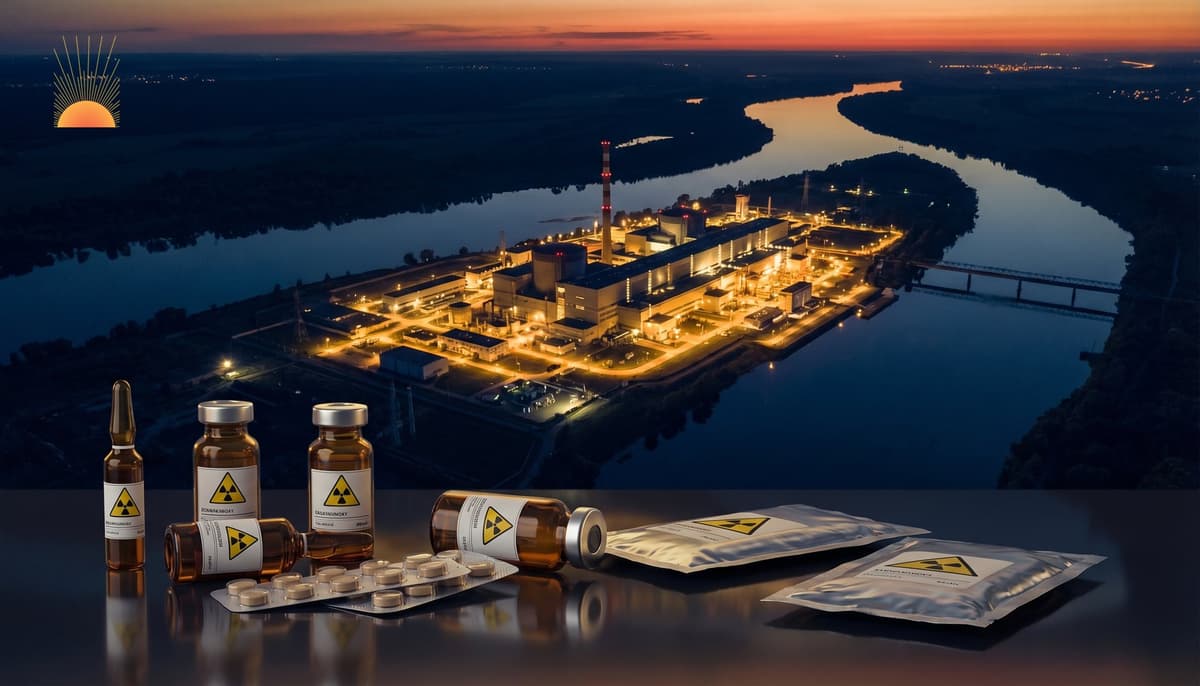
The ongoing escalation involving the United States, Israel, and Iran has placed the world at a critical geopolitical juncture — one where conflict and nuclear risk intersect in ways the international community cannot afford to ignore. For institutional emergency planners, defence medical authorities, and procurement teams across the GCC and beyond, this is no longer a theoretical scenario. It is an operational planning reality.
In nuclear emergencies, the window between preparedness and exposure is measured in hours. The institutions that act before the crisis define the outcomes for the populations they protect.
The Current Threat Landscape
Recent developments around the Bushehr Nuclear Power Plant have intensified global concern. While no major radiological release has been confirmed at the time of publication, the International Atomic Energy Agency (IAEA) has consistently warned that any damage to an operational reactor could trigger a large-scale nuclear emergency with cross-border consequences affecting multiple nations.
The World Health Organization (WHO) has repeatedly emphasised that nuclear incidents are not localised events. They are regional, long-term public health crises — affecting water safety, food chain integrity, and population health across entire geographies for years or decades following the initial event.
When an operational nuclear facility is located within a conflict zone, emergency preparedness transitions from a national civil defence matter to a multi-country procurement and stockpiling priority. Governments and health authorities in the Gulf region, South Asia, and Eastern Europe are all within potential fallout corridors depending on wind patterns and reactor type.
Internal Contamination: The Primary Medical Threat
In nuclear exposure scenarios, the greatest danger is not always immediate external radiation — it is internal contamination, where radioactive isotopes enter the body through inhalation of contaminated air, consumption of contaminated water or food, and environmental fallout deposition. Once inside, these isotopes accumulate in specific organs and continue to irradiate tissue over time.
The three primary radionuclides of concern in a reactor incident are:
Rapidly absorbed by the thyroid gland. Causes radiation-induced thyroid damage and significantly increases the risk of thyroid cancer, particularly in children and adolescents. Half-life: 8 days — concentrated exposure in the first days after release.
Distributes throughout soft tissue and organs, causing systemic contamination. Half-life of approximately 30 years — long-term internal irradiation risk. Was the primary contaminant in the Goiânia incident (1987) and a major concern in post-Chernobyl populations.
Chemically similar to calcium — deposits in bone and bone marrow. Causes long-term internal irradiation with elevated risk of bone cancer and leukaemia. Half-life: ~29 years.
These contaminants are not contained by national borders. They travel via atmospheric dispersion, marine current circulation, and agricultural supply chains — making regional preparedness a collective institutional responsibility, not a unilateral one.
Potassium Iodide: The Critical Thyroid Blocking Window
Potassium iodide (KI) is the globally recognised first-line countermeasure against radioactive iodine (I-131) uptake by the thyroid gland. Its mechanism is straightforward: by saturating the thyroid with stable (non-radioactive) iodine before or immediately after exposure, KI prevents the gland from absorbing the radioactive variant.
According to WHO guidelines on iodine thyroid blocking (ITB), the optimal administration window is less than 24 hours before — or up to 2 hours after the onset of exposure. Effectiveness decreases significantly beyond 8 hours post-exposure. This is not a drug that can be ordered after the crisis begins and still be effective. It must be pre-positioned in institutional stockpiles.
KI is recommended for thyroid protection by the U.S. Centers for Disease Control and Prevention (CDC), the WHO, the IAEA, and the U.S. FDA. It is included in national emergency stockpiling frameworks in the United States, European Union member states, Japan, and South Korea. It is notably under-stockpiled across much of the MENA region despite the region's proximity to multiple operating nuclear facilities.
Golden Hour Pharma manufactures pharmaceutical-grade potassium iodide tablets from a WHO-approved facility, available for institutional and government procurement in tablet dosage forms aligned with WHO recommended dosage schedules.
Prussian Blue: Cesium Decorporation
For internal contamination with radioactive cesium (Cs-137), the globally approved medical countermeasure is Prussian blue (ferric hexacyanoferrate). Unlike KI — which is a preventive agent — Prussian blue is a treatment administered after confirmed or suspected internal contamination has occurred.
Its mechanism: Prussian blue acts as an oral ion-exchange resin in the gastrointestinal tract, binding radioactive cesium and preventing its reabsorption. The bound cesium is then eliminated through bowel movements, reducing the total body radiation dose. According to the CDC, Prussian blue has been shown to reduce the whole-body effective half-life of cesium-137 by up to 69% in adults. It was approved by the U.S. FDA in 2003 and is included in the U.S. Strategic National Stockpile.
| Countermeasure | Targets | Mechanism | Timing | Regulatory Status |
|---|---|---|---|---|
| Potassium Iodide (KI) | Iodine-131 (thyroid) | Thyroid saturation — blocks I-131 uptake | Pre-exposure or within 2 hrs post-exposure | WHO, CDC, FDA, IAEA recommended |
| Prussian Blue | Cesium-137 (systemic) | Ion-exchange — binds Cs in GI tract, enhances elimination | Post-exposure treatment | FDA approved (2003), Strategic National Stockpile |
Golden Hour Pharma manufactures Prussian blue in two formulations: standard Prussian blue for civilian protection protocols, and a proprietary Prussian Blue with Magnesium formulation designed for frontline responders operating in high-risk exposure environments — the only such formulation available globally at scale.
The Global Preparedness Gap
Despite clear WHO, IAEA, and national regulatory frameworks recommending pre-positioned stockpiles of nuclear emergency countermeasures, the institutional gap between policy and operational readiness remains significant across most regions outside North America, Western Europe, and East Asia.
Most institutional procurement systems are designed for planned supply cycles, not crisis-response timelines. When a nuclear emergency is declared, the same procurement constraints — tender processes, approval chains, lead times — that apply to routine orders also apply to emergency orders. This is structurally incompatible with a 2-hour effective window for KI.
Global pharmaceutical supply chains consolidate under stress. During the COVID-19 pandemic, supply chains for basic medicines collapsed within weeks. A nuclear emergency creates simultaneous demand spikes across multiple countries from a narrow pool of qualified manufacturers. Reactive procurement in this environment yields neither timely nor affordable supply.
For institutional emergency preparedness programmes, this translates to a specific procurement mandate: nuclear antidotes must be stockpiled in advance, replenished on shelf-life rotation schedules, and sourced from manufacturers with proven large-scale surge capacity.
Golden Hour Pharma's Manufacturing Capability
Golden Hour Pharma is a specialist nuclear emergency antidote manufacturer, not a general pharmaceutical distributor. The distinction matters for procurement planners evaluating supply security during geopolitical stress periods.
- WHO-approved manufacturing facility — audited production standards
- Large-scale production capacity — surge output for government and institutional orders
- 750+ pharmaceutical products across tablets, capsules, injectables, syrups, ointments, eye drops, and ear drops
- Regional partners in Saudi Arabia, UAE, and Bahrain
- Active supply to 30+ countries worldwide
Within its emergency antidote portfolio, Golden Hour Pharma manufactures:
Pharmaceutical-grade thyroid blocking agent. Available for government emergency stockpiling programmes and institutional preparedness procurement across GCC and international markets.
Cesium decorporation agent for civilian protection protocols. FDA-approved mechanism of action. Manufactured under GMP-compliant conditions for institutional stockpile orders.
Proprietary formulation designed for frontline responders in high-risk exposure environments. Enhanced resilience support for emergency response personnel. The only globally available formulation of this type at scale.
Our operational differentiation is not in product range alone — it is in compliance infrastructure, pricing stability, and delivery reliability under the exact conditions where other supply chains fail. Where others struggle with pricing volatility and post-crisis sourcing, Golden Hour Pharma maintains pre-committed institutional supply agreements with guaranteed delivery readiness.
The Case for Acting Before the Crisis
Nuclear preparedness is no longer an optional consideration for governments and health ministries in the GCC and surrounding regions. The combination of active conflict near operational nuclear infrastructure, GCC geographic vulnerability, and the narrow therapeutic window for nuclear antidotes creates a clear strategic imperative: pre-position emergency stockpiles now.
The risk calculus is asymmetric. The cost of maintaining a rotational stockpile of KI and Prussian blue is a fraction of the cost — financial, political, and human — of managing a nuclear health emergency with no pre-positioned supply. History at Chernobyl, Fukushima, and Goiânia confirms this asymmetry repeatedly. The difference between a managed emergency response and a mass casualty catastrophe is, in each case, the same variable: what was prepared before the event occurred.
- Potassium Iodide (KI) — Pharmaceutical Grade Institutional Supply
- Prussian Blue (Ferric Hexacyanoferrate) — Radiation Decontamination Supplier
- Potassium Iodate (KIO3) — Thyroid Protection for Institutional Stockpiles
- Full Nuclear Emergency Antidote Range
- Emergency Medicine Procurement — Institutional Supply Partner