
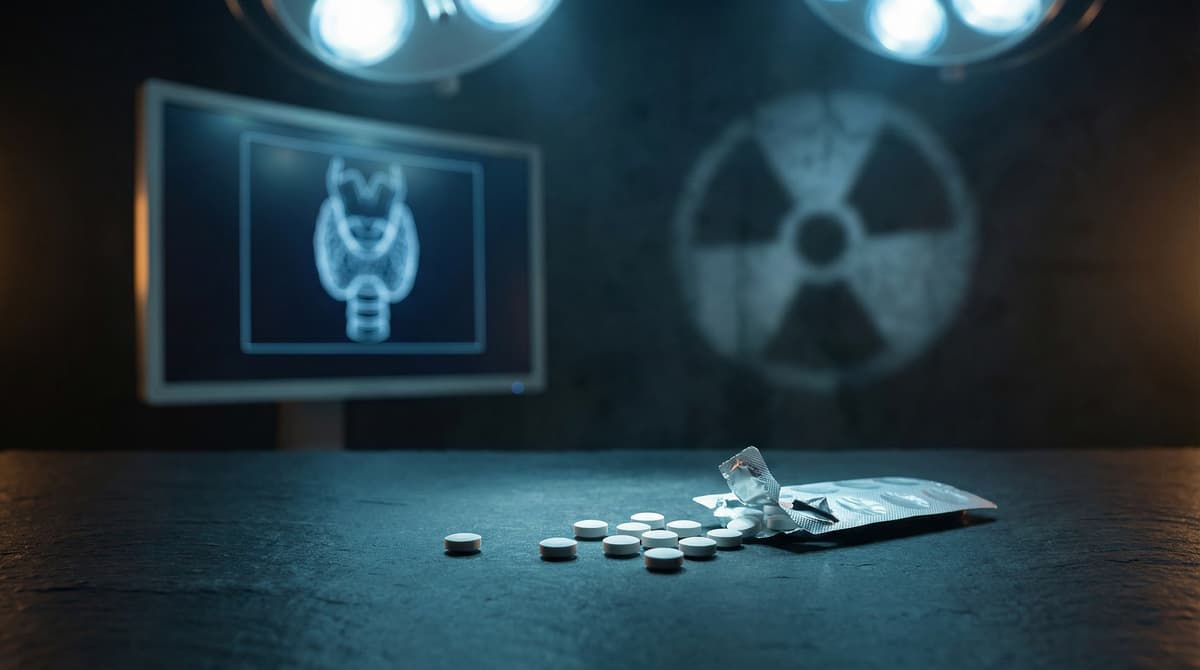
Potassium Iodide (KI) is one of the most strategically important medicines in emergency preparedness — and one of the most misunderstood.
For institutional buyers, the question is rarely whether to procure KI — it is how: which grade, what quantity, from which supplier, under what quality assurance framework, and alongside which complementary medicines.
What Is Potassium Iodide (KI)?
Potassium Iodide is an inorganic chemical compound — the iodine salt of potassium — with the molecular formula KI. In pharmaceutical contexts, it is a stable, non-radioactive form of iodine manufactured to pharmacopoeia-grade standards for therapeutic use in nuclear and radiological emergencies.
The pharmaceutical forms in widespread institutional use are oral tablets (32 mg, 65 mg, and 130 mg strengths) and oral solution. KI is listed on the WHO Model List of Essential Medicines specifically for its role in nuclear emergency response — a designation that informs national stockpile requirements in countries aligned with WHO preparedness frameworks.
Important: What KI is NOT
- Not a general radiation antidote
- Does not protect against whole-body radiation exposure
- Does not decontaminate other radioisotopes (caesium, thallium)
- Specific use only: thyroid protection against radioiodine (I-131)
Institutions requiring broader radiological protection should assess complementary medicines such as Prussian Blue (Ferric Hexacyanoferrate) for internal caesium and thallium decontamination.
How Does Potassium Iodide Protect the Thyroid?
The thyroid gland actively absorbs iodine from the bloodstream to produce thyroid hormones. In a nuclear emergency involving the release of radioactive iodine (I-131), the thyroid cannot distinguish between stable iodine and radioactive iodine — it will absorb both indiscriminately.
KI works by saturating the thyroid with stable iodine before — or shortly after — radioactive iodine exposure. A thyroid already fully saturated has no capacity to absorb additional iodine. Radioactive I-131 passes through without retention, substantially reducing thyroid dose and the associated risk of radiation-induced thyroid cancer.
Timing Is the Critical Variable
Maximum efficacy — thyroid fully saturated in advance
Still highly effective if administered promptly
Efficacy diminishes significantly
Minimal therapeutic benefit
This timing dependency is the central reason why pre-positioning and national stockpiling matter. Populations and frontline responders cannot wait for supply to be arranged after an event — the medicine must already be accessible at the point of need.
When Is KI Used? Institutional and National Context
Potassium Iodide is indicated for deployment in two primary emergency scenarios:
Nuclear Power Plant Accidents
Radioactive iodine is a major fission product released in reactor accidents. Chernobyl (1986) and Fukushima (2011) both triggered large-scale KI distribution programmes. Post-Fukushima WHO/IAEA guidance updated coverage zones significantly.
Nuclear Detonation & Dirty Bomb Scenarios
Military and civil defence planners increasingly account for intentional radiological incidents, including improvised radiological devices and tactical nuclear events in contested regions.
WHO guidance recommends that governments with populations within 100 km of nuclear facilities maintain pre-distributed KI stockpiles. For hospitals and healthcare institutions in high-risk zones, maintaining a KI stockpile is part of broader emergency medicine preparedness — ensuring staff, patients, and first responders can receive prompt thyroid protection without depending on national distribution chains that may be disrupted in a crisis.
What Grades and Forms Are Used in Institutional Procurement?
Procurement officers should specify pharmacopoeia grade at the point of inquiry. The three internationally recognised grades are:
| Grade | Standard Body | Common Markets | Strengths |
|---|---|---|---|
| USP | United States Pharmacopeia | Americas, Middle East, Asia | 32 mg, 65 mg, 130 mg |
| BP | British Pharmacopoeia | UK, Commonwealth, Africa, MENA | 32 mg, 65 mg, 130 mg |
| IP | Indian Pharmacopoeia | South Asia, select African markets | 32 mg, 65 mg, 130 mg |
WHO-Recommended Dosage by Age Group
| Age Group | Recommended Dose | Tablet Strength |
|---|---|---|
| Neonates (0–1 month) | 16 mg | ½ × 32 mg tablet |
| Infants (1 month – 3 years) | 32 mg | 1 × 32 mg tablet |
| Children (3–18 years) | 65 mg | 1 × 65 mg tablet |
| Adults (18 years and over) | 130 mg | 1 × 130 mg tablet or 2 × 65 mg |
Based on WHO/IAEA guidance. Dosing should align with the national regulatory protocol applicable in your jurisdiction.
Shelf life is typically 5 years from date of manufacture under correct storage conditions. Golden Hour Pharma supplies pharmaceutical-grade Potassium Iodide in USP, BP, and IP grades — including 32 mg, 65 mg, and 130 mg strengths — with full batch documentation and customisable packaging on inquiry.
Key Questions Procurement Teams Should Ask Their Supplier
Not all KI on the market is equivalent. These five due diligence questions should be answered by any supplier before a purchase order is raised:
1. Is it pharmacopoeia grade (USP, BP, or IP)?
Grade must match the regulatory standard required by your market or ministry. Ungraded or industrial-grade KI is not suitable for pharmaceutical use.
2. Is the manufacturing facility WHO-GMP certified?
WHO Good Manufacturing Practice certification confirms the facility operates under validated quality systems — a minimum threshold for institutional procurement.
3. Is a Certificate of Analysis (CoA) available per batch?
A CoA documents assay results, impurity testing, and specification compliance for each manufactured lot — the primary quality verification document.
4. What are lead times and minimum order quantities?
Strategic stockpile procurement typically involves larger volumes and longer advance planning windows. Confirm these upfront.
5. Is custom labelling available for national programmes?
Governments running pre-distribution programmes often require country-specific labelling, local language instructions, and branded packaging.
For a full overview of compliance standards, see our Quality and Compliance page.
Potassium Iodide vs Potassium Iodate — Which Should You Procure?
Both KI and Potassium Iodate (KIO3) serve the same core function — thyroid blocking against radioiodine — but differ in chemical stability, shelf life, and regulatory acceptance.
Potassium Iodide (KI)
- Standard in USFDA and EU-aligned markets
- Well-established WHO/IAEA protocols
- Widely available in USP and BP grade
- Preferred for hospital and clinical settings
Potassium Iodate (KIO3)
- Chemically more stable in humid/tropical climates
- Favoured for national pre-distribution programmes
- Longer effective shelf life in field conditions
- Preferred by several African and MENA authorities
The decision should be driven by local regulatory requirements, climate and storage considerations, and alignment with national emergency response protocols. Both compounds are available through Golden Hour Pharma in pharmacopoeia-compliant grades.
Why a Complete Nuclear Antidote Programme Matters
A well-designed institutional stockpile does not rely on KI alone. In any significant nuclear or radiological event, the contamination profile extends well beyond radioiodine:
- Caesium-137 (Cs-137): Major component of nuclear fallout — causes internal contamination via ingestion and inhalation, accumulating across multiple organ systems. KI provides no protection.
- Thallium: Damages multiple organ systems. Requires a separate treatment protocol.
- External radiation: Whole-body radiation exposure — KI does not protect against this at all.
The WHO-endorsed treatment for internal Cs-137 contamination is Prussian Blue (Ferric Hexacyanoferrate), which binds radioactive caesium in the GI tract and substantially reduces its biological half-life from ~110 days to ~30 days. A procurement strategy limited to KI provides only partial protection.
For the full range of medicines required for nuclear preparedness, see our Nuclear Antidotes and Radiation Countermeasures page.
Procurement Summary
Potassium Iodide remains a foundational medicine in nuclear emergency preparedness. Its effectiveness is proven, its mechanism is well-understood, and its place in WHO and IAEA emergency protocols is established.
For institutional buyers, the key procurement considerations are pharmacopoeia grade, manufacturer quality certification, batch documentation, lead time, and the broader medicine mix required for a complete preparedness programme.
Ready to discuss your Potassium Iodide procurement requirements?
Golden Hour Pharma supplies USP, BP, and IP grade KI from WHO-GMP certified manufacturers, with full batch traceability and custom packaging for national stockpile programmes.