
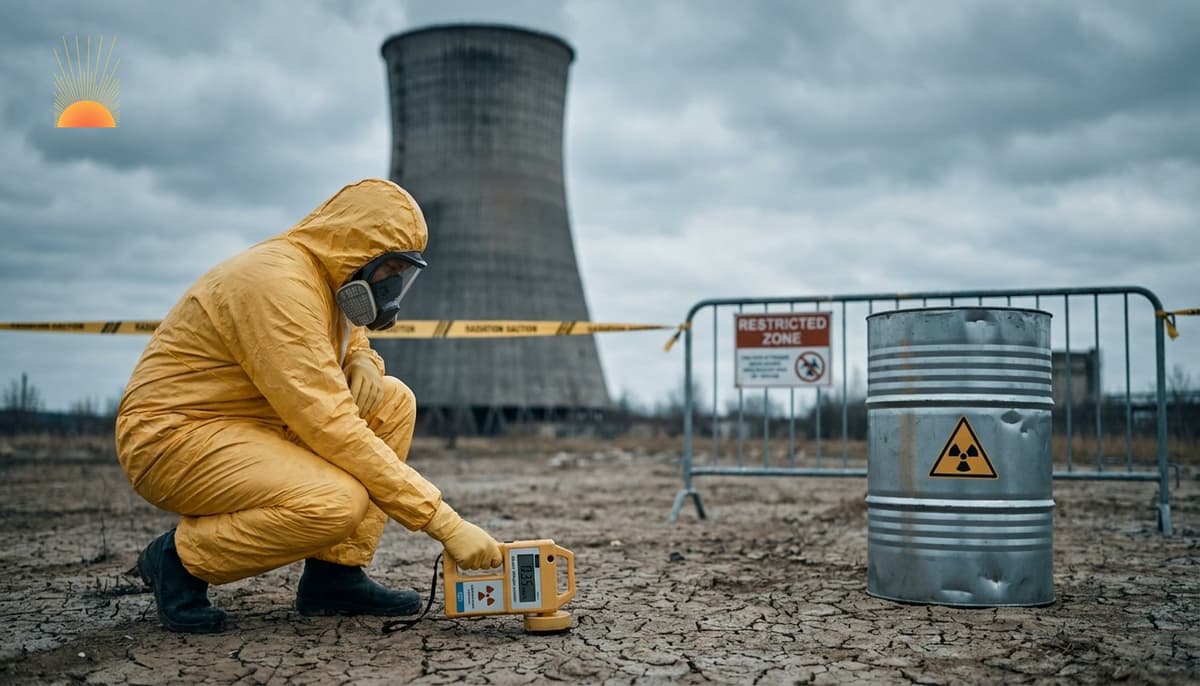
Radiological contamination is one of the most complex environmental challenges because it is invisible, long-lasting, and isotope-dependent. Unlike chemical pollution, radioactive contamination involves unstable atoms that decay over time while emitting ionizing radiation.
Global frameworks by the International Atomic Energy Agency (IAEA), World Health Organization, and U.S. Environmental Protection Agency define strict protocols for detection, cleanup, disposal, and human resettlement.
Radiation Detection and Monitoring Equipment
Scintillation Detectors
Used to detect gamma radiation through light flashes in crystals.
- Very sensitive
- Used in laboratories and emergency response
- Detects low-level contamination in food, soil, water, air
Source: IAEA Radiation Detection Handbook
Geiger-Müller Counters
- Detect alpha, beta, gamma radiation
- Provide readings in CPM or µSv/h
- Used for rapid field surveys
Source: U.S. NRC Radiation Detection Guide
Gamma Spectrometers
- Identify specific isotopes (Cs-137, I-131, Sr-90)
- Used for lab-based environmental analysis
Source: IAEA Environmental Monitoring Standards
Air Sampling Systems
- Collect radioactive particles from atmosphere
- Filters analyzed for radionuclides
Source: WHO Radiation Emergency Guidelines
Soil, Water, Food Testing Systems
- Measure contamination in ecosystems
- Detect long-lived isotopes like Cesium-137
What Do Radiation Readings Mean?
Measured in µSv/h (microsievert per hour):
| Reading (µSv/h) | Classification |
|---|---|
| 0.05–0.2 | Natural background |
| 0.2–1 | Slightly elevated |
| 1–10 | Contaminated zone (restricted use) |
| 10 | High-risk / evacuation |
| 100 | Severe emergency zone |
Source: ICRP Publication 103, IAEA GSR Part 3
What Is Contamination?
Contamination means:
It can be:
- External (surface contamination)
- Internal (ingested or inhaled)
Source: WHO Radiation Emergency Manual
Can Contaminated Material Be Cleaned?
Low-Level Contamination
- Washing, surface removal, chemical decontamination
- Example: tools, clothing, surfaces
Medium-Level
- Requires controlled decontamination
- Waste removed and treated separately
High-Level
- Cannot be reused
- Must be treated as radioactive waste
What Is Done With Contaminated Material?
Collection
- Contaminated soil, debris, clothing, food, water filters are collected separately
- Packed in shielded containers (lead-lined or concrete containers)
Treatment Options
1. Incineration (for certain organic waste)
- Reduces volume
- Ash becomes radioactive waste requiring disposal
2. Cementation / Vitrification
- Waste mixed with cement or glass
- Locked into stable solid form
3. Compaction
- Reduces waste volume for storage
Source: IAEA Waste Management Standards (WS-G-2.3)
Final Disposal (Buried Waste)
Radioactive waste is disposed in:
Near-surface repositories
- Low-level waste
- Shallow burial with engineered barriers
Deep geological repositories
- High-level waste
- Hundreds of meters underground in stable rock formations
Examples:
- Finland's Onkalo repository (deep geological disposal model)
- France's ANDRA facility
Source: IAEA Deep Geological Disposal Guidelines
What Happens to the Land After Contamination?
Step 1: Zoning
Areas are classified as:
- Restricted zone
- Controlled zone
- Exclusion zone
Step 2: Decontamination
Methods include:
- Removing topsoil (5–20 cm)
- Washing surfaces
- Chemical binding agents
- Forest/vegetation removal
Step 3: Natural Decay
Some isotopes decay naturally:
- Iodine-131 → days
- Cesium-137 → ~30 years
- Strontium-90 → ~28 years
Step 4: Long-Term Restriction or Release
Depending on contamination level:
Can be reused:
- After radiation levels fall below safety thresholds (ICRP limits)
Restricted use:
- Limited agriculture or forestry allowed
Permanent exclusion:
- In extreme contamination zones (hot spots)
Can People Live Again in Contaminated Areas?
Yes — BUT ONLY UNDER CONDITIONS.
Reoccupation is allowed when:
- Radiation levels fall within regulatory limits
- Environmental remediation is completed
- Long-term monitoring confirms safety
Example:
- Parts of Fukushima exclusion zones are gradually being reopened under strict monitoring
In severe zones:
- Areas may remain uninhabitable for decades or longer
- Depends on isotopes like Cs-137 and Pu-239
Source: WHO & IAEA post-accident recovery frameworks
Key Scientific Principles
Radiation safety decisions depend on:
- Type of isotope
- Half-life
- Dose rate (µSv/h)
- Exposure pathway (air, food, water)
- Population risk
Source: IAEA GSR Part 3, ICRP 103
Antidotes: The Critical Medical Response Layer
Detection identifies risk—but antidotes protect human life.
Essential Radiation Antidotes
Potassium Iodide (KI)
Blocks thyroid uptake of radioactive iodine (I-131). Most effective when administered early.
Prussian Blue
Binds radioactive Cesium-137 and Thallium in the gastrointestinal tract and enhances elimination from the body.
Advanced Formulation Approach
Golden Hour Pharma is the only company to introduce Prussian Blue with Magnesium, designed for enhanced frontline response capability.
Benefits of Magnesium Integration:
- Supports cellular stability under radiation stress
- Improves neuromuscular and cardiovascular function
- Helps maintain electrolyte balance during prolonged exposure
👉 Highly recommended for rescue responders and frontline teams
👉 Standard Prussian Blue remains suitable for civilians
Side Effects
Prussian Blue:
- Constipation
- Gastrointestinal discomfort
- Stool discoloration
Magnesium (when added):
- Requires controlled dosing in renal-compromised patients
- Should be used under medical supervision
Golden Hour Pharma — Strategic Partner for Nations
We are not just a company… we are a force.
Ready when it matters most.
Global Presence
- Strong regional partners in UAE, Saudi Arabia, and Bahrain
- Supplying to 30+ countries worldwide
Core Expertise
- Portfolio of 750+ products
- Specialized in:
- Antidotes
- Oncology
- Autoimmune medicines
- Critical therapeutic products
Operational Strength
- WHO-compliant manufacturing facilities
- Rapid response and emergency supply capability
- Strong distribution and logistics network
Where others face challenges in delivery and pricing, we ensure continuity of supply, stable access, and unwavering commitment to national preparedness.
Final Summary
- Contamination can be temporary or permanent depending on isotope and exposure
- Monitoring systems define risk zones
- Waste is treated, contained, and buried under strict global protocols
- Land can sometimes be reused—but requires time, science, and control
- Antidotes play a critical role in saving lives during exposure
Final Statement