
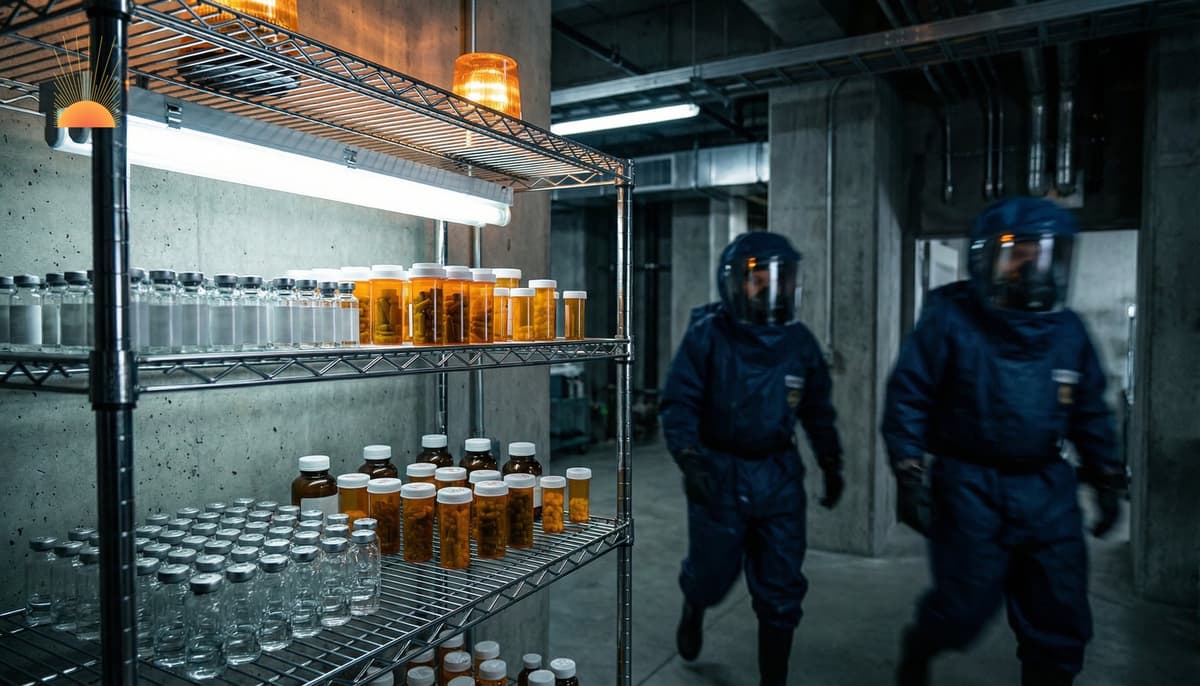
In every major radiological emergency studied by the WHO, IAEA, and CDC, the highest-consequence decisions are not made by governments in the first hour — they are made by individuals. Those decisions determine exposure levels, internal contamination risk, and long-term health outcomes. The science of survival in a radiation emergency is well established. The gap is not knowledge — it is readiness.
Radiation emergencies are not won by movement. They are survived by stillness, shelter, and the right medical countermeasures administered in time.
The First Hour: Where Survival Is Decided
The clinical and emergency preparedness literature is consistent on one point: the first 60 minutes of a radiological event define three outcomes that are difficult or impossible to reverse later — external exposure level, internal contamination risk, and the window for effective medical intervention.
According to the WHO Radiation Emergency Medical Management guidelines, time-distance-shielding is the foundational protection framework. Every minute of unnecessary outdoor exposure adds to the total absorbed dose. Every action that keeps a person outside — or moves them toward the source — compounds harm.
The principle is straightforward: the more dense material between a person and the external environment, the lower the radiation dose. A basement provides significantly more shielding than a ground floor. A central interior room provides more than a room with external windows. Movement into the open — especially without direction — eliminates all shielding benefit immediately.
Behavioral Failures That Increase Exposure
Emergency preparedness research and post-incident analysis consistently identify a cluster of instinctive responses that significantly increase exposure during the critical first hour. These are not failures of intent — they are the predictable outputs of untrained human behavior under acute shock.
Understanding these failure modes is not academic. For ministries, hospital administrators, and defence medical planners, building preparedness protocols that specifically address these instincts — through training, communication, and pre-positioned medical assets — is the operational priority.
Sheltering: The Principle of Protection
The IAEA General Safety Requirements on preparedness and response establish shelter-in-place as a core protective action for the early phase of radiological emergencies. The protective factor of a shelter depends on its construction material and geometry.
Optimal shelter locations in order of effectiveness:
- Basement levels of concrete or brick buildings — highest protection factor; surrounding mass significantly attenuates gamma radiation
- Interior rooms on lower floors — reduces direct gamma exposure and limits inhalation of contaminated outside air
- Multi-storey concrete structures — upper floors away from windows, using the building's mass as shielding
Locations to avoid:
- Vehicles — provide minimal shielding and may be moving through contaminated areas
- Buildings with large glass surfaces or open-plan ground floors
- Open roads, fields, or any unobstructed outdoor space
Decontamination: The Second Critical Step
For individuals who were outdoors during the initial event or fallout deposition, decontamination before or upon entering shelter is essential. The CDC estimates that removing outer clothing can eliminate up to 90% of external radioactive material. This single action has a disproportionate impact on dose reduction.
Field decontamination protocol:
- Remove outer clothing (coat, jacket, shoes) and seal in a plastic bag
- Move the sealed bag away from people — outside the shelter if possible
- Shower thoroughly with soap and water; do not scrub skin aggressively
- Clean hair with shampoo — do not use conditioner, which can bind particles
- Change into clean, sealed clothing stored indoors
- Blow nose and wipe around eyes and ears gently with a clean damp cloth
This is not a clinical procedure. It is achievable by any prepared individual with basic materials and clear prior instruction. For institutional planners, this reinforces the value of pre-incident public communication and preparedness training — not just stockpiling medicines, but ensuring people know how to use what is available.
Emergency Preparedness Essentials
Institutional emergency preparedness frameworks — including those published by the WHO and the IAEA — emphasise that individual and household preparedness is the first layer of resilience before institutional systems can respond. A minimum preparedness kit for a radiation emergency should include:
Medical Countermeasures: The Overlooked Layer
Physical protective actions — sheltering, decontamination, distance — address external exposure. They do not address internal contamination, which occurs when radioactive particles are inhaled, ingested, or absorbed through open wounds. Internal contamination cannot be washed off. It continues delivering radiation dose to surrounding tissues until it decays naturally or is medically accelerated out of the body.
This is the domain of pharmaceutical medical countermeasures, and it is the most under-resourced layer of most national preparedness frameworks.
Potassium Iodide (KI) — Thyroid Protection from Iodine-131
Iodine-131 is released during nuclear fission events. It concentrates in the thyroid gland, delivering prolonged radiation dose that significantly elevates the risk of thyroid cancer — particularly in children. Potassium Iodide (KI) saturates the thyroid with stable iodine before or shortly after exposure, blocking uptake of radioactive iodine entirely.
KI must be administered within the correct window. According to the FDA guidance on Potassium Iodide, the recommended dosage by age group is:
| Age Group | Recommended KI Dose | Available Strength |
|---|---|---|
| Adults 18–40 years (incl. pregnant/lactating) | 130 mg | 130 mg tablet or 2 × 65 mg tablets |
| Adults over 40 years (high-dose exposure only) | 130 mg | 130 mg tablet |
| Adolescents 12–18 years | 65 mg (130 mg if >70 kg) | 65 mg tablet or half of 130 mg tablet |
| Children 3–12 years | 65 mg | 65 mg tablet |
| Children 1 month to 3 years | 32.5 mg | 65 mg tablet (half) or oral solution |
| Neonates (birth to 1 month) | 16.25 mg | Oral solution (65 mg/mL) |
KI is available in three pharmaceutical forms: 65 mg tablets, 130 mg tablets, and oral solution (65 mg/mL) for paediatric and neonatal use. Institutional procurement should account for the full population range — including hospitals and paediatric facilities that require liquid formulations.
Prussian Blue — Cesium-137 and Thallium Decorporation
Cesium-137 is one of the most commonly released isotopes in nuclear incidents and behaves similarly to potassium — distributing throughout soft tissue and muscle. Thallium, used in industrial and medical settings, causes severe neurological and multi-organ toxicity. For both, Prussian Blue (Ferric Hexacyanoferrate) is the FDA-approved treatment.
Prussian Blue works by binding cesium and thallium ions in the intestine, preventing reabsorption through the enterohepatic circulation, and accelerating elimination via the faeces. The FDA approval of Prussian Blue Insoluble (ferric hexacyanoferrate) for internal contamination by radioactive cesium and thallium provides the regulatory foundation for national stockpiling decisions.
Prussian Blue and the Magnesium Advantage
Tolerability is a practical concern in mass casualty scenarios. A formulation that causes significant gastrointestinal distress reduces patient compliance, complicates institutional administration, and creates additional burden on medical staff managing large-scale response.
Magnesium plays a critical supportive role in radiation emergency medical management:
- Reduces gastrointestinal side effects associated with Prussian Blue treatment
- Supports electrolyte stability, particularly potassium balance, which is disrupted by cesium-137 contamination
- Maintains cardiac and neuromuscular function during prolonged treatment
- Improves patient tolerance and compliance in extended treatment courses
Golden Hour Pharma is the only company to introduce a Prussian Blue formulation with Magnesium — available in two variants: an enhanced-tolerance formulation for frontline medical personnel and a standard Prussian Blue formulation for civilian population use. This distinction reflects the different clinical demands of emergency responders versus the general population in a mass casualty event.
For institutional procurement officers evaluating medical countermeasure stockpiles, formulation tolerability is not a minor detail — it is a practical factor that determines whether treatment is maintained for the full clinical course. Explore the full nuclear emergency antidote portfolio for procurement specifications.
Global Scientific Consensus and the Real Gap
The science of radiation emergency response is not uncertain. The WHO, IAEA, CDC, and UNSCEAR have collectively:
- Validated the mechanism and efficacy of KI for thyroid protection
- Established Prussian Blue as the standard of care for cesium and thallium internal contamination
- Published shelter-in-place and decontamination protocols as primary protective actions
- Issued stockpiling guidance for national preparedness programmes
The gap is not scientific — it is operational. In real emergencies, delays in medical countermeasure administration occur because stockpiles were not pre-positioned, distribution systems were not tested, and population awareness was insufficient. In radiation emergencies, delay is not a logistical inconvenience. It is the difference between effective thyroid blockade and irreversible uptake — between accelerated cesium elimination and systemic organ damage.
Golden Hour Pharma: Ready When It Matters Most
Golden Hour Pharma is a WHO-GMP certified pharmaceutical supplier specialising in nuclear emergency medicines and emergency preparedness supply for institutional buyers. Our portfolio addresses the full spectrum of radiological countermeasures — from thyroid protection to internal contamination treatment — with a focus on regulatory compliance, supply reliability, and crisis-responsive delivery.
Core capabilities:
- WHO-approved manufacturing facility with large-scale production capability
- Specialised in nuclear emergency medicines: Potassium Iodide, Prussian Blue with Magnesium, Potassium Iodate
- Regional partners in Saudi Arabia, UAE, and Bahrain; presence in 30+ countries
- Pricing, supply continuity, and delivery timelines designed for emergency procurement
For procurement officers planning emergency stockpile acquisitions, review our quality and compliance documentation or submit a procurement enquiry to discuss volume requirements, lead times, and regulatory specifications.
In radiation emergencies, every layer of the response matters — and the pharmaceutical layer is often the last to be resourced and the first to be needed.