
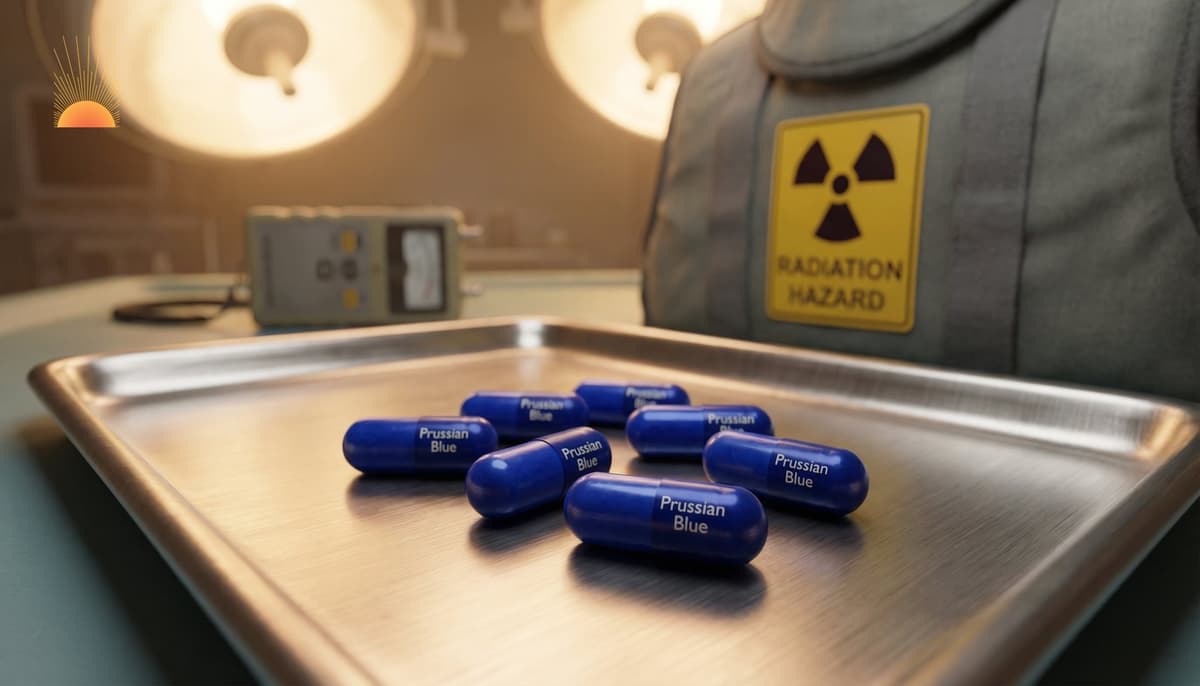
Prussian Blue — known chemically as ferric hexacyanoferrate — is the only FDA-approved treatment for internal contamination with radioactive caesium-137 and thallium. For governments, hospitals, and defence agencies responsible for nuclear emergency preparedness, understanding how this medicine works, when it is needed, and how to procure it is not optional — it is a readiness requirement.
What Is Prussian Blue and Why Does It Matter in Radiation Emergencies?
Prussian Blue (insoluble ferric hexacyanoferrate, Fe₄[Fe(CN)₆]₃) is a pharmaceutical-grade compound that acts as a decorporation agent — a medicine that accelerates the removal of radioactive materials from the human body. It has been approved by the U.S. FDA, endorsed by the CDC, and included on the WHO Model List of Essential Medicines — designating it as a critical stockpile item for national emergency preparedness programmes worldwide.
Unlike potassium iodide, which protects the thyroid from radioactive iodine, Prussian Blue addresses a different and equally critical threat: radioactive caesium and thallium that enter the body through ingestion, inhalation, or wound contamination. These isotopes distribute throughout soft tissue and organs, delivering prolonged internal radiation doses if untreated.
Prussian Blue is listed on the WHO List of Essential Medicines and is included in the U.S. Strategic National Stockpile (SNS) maintained by HHS/ASPR for radiological and nuclear emergencies.
How Prussian Blue Works: Mechanism of Action
Prussian Blue works through a combination of three mechanisms inside the gastrointestinal tract:
The crystal lattice of Prussian Blue exchanges potassium ions for caesium or thallium ions, trapping them within the molecular structure. The crystal channel diameter (~3.2 Å) closely matches the hydration radius of caesium ions, enabling highly selective binding.
Caesium and thallium ions adsorb onto the surface of Prussian Blue particles in the gut, preventing their reabsorption into the bloodstream through the intestinal wall.
After initial absorption, caesium is excreted by the liver into bile and re-enters the intestine. Prussian Blue binds it at this stage, breaking the reabsorption cycle and forcing elimination through faeces rather than recirculation.
Critically, insoluble Prussian Blue is not absorbed through the gastrointestinal wall. It passes through the body, carrying bound caesium and thallium with it. This means it acts locally in the gut without entering systemic circulation — a significant safety advantage.
Clinical Effectiveness: What the Evidence Shows
The clinical evidence for Prussian Blue is built on real-world emergency use, most notably the 1987 Goiânia radiological accident in Brazil — one of the worst radiological incidents in history.
A disused radiotherapy source containing caesium-137 was scavenged and opened in Goiânia, Brazil, contaminating 249 people and killing four. Approximately 112,000 residents were monitored. 46 patients were treated with Prussian Blue, which reduced the biological half-life of Cs-137 and decreased the absorbed radiation dose by an average of 71%.
These are not theoretical figures. They come from documented emergency treatment of real patients under crisis conditions, validated by the International Atomic Energy Agency (IAEA).
Dosage, Administration, and Treatment Duration
According to the FDA-approved prescribing information for Prussian Blue (ferric hexacyanoferrate), the dosage protocol is:
| Patient Group | Dosage | Frequency |
|---|---|---|
| Adults and Adolescents (13+ years) | 3 grams | Three times daily |
| Children (2–12 years) | 1 gram | Three times daily |
Key Administration Notes
- Take with food to stimulate bile excretion and enhance caesium/thallium elimination
- Treatment duration: Typically 30 days or longer, guided by weekly monitoring of radioactivity in urine and faecal samples
- Initiate as soon as possible after suspected contamination — but even delayed treatment is effective and should not be withheld
- Capsules may be opened and mixed with food or liquid for patients who cannot swallow capsules (particularly children)
- Monitoring: Weekly complete blood count, serum chemistry, electrolytes, and radiation measurements
Clinical Note: Hypokalemia was reported in approximately 7% of patients during Prussian Blue treatment. Electrolyte monitoring is essential throughout the treatment course. Prussian Blue can also decrease gastrointestinal motility, which may require clinical management in some patients.
When Is Prussian Blue Needed? Exposure Scenarios
Prussian Blue is specifically indicated for internal contamination with caesium-137 or thallium. The scenarios that require its deployment include:
A radiological dispersal device that spreads Cs-137 — one of the most commonly cited radiological threats. Inhalation and ingestion of contaminated dust are the primary exposure routes.
Reactor accidents or attacks on nuclear sites can release Cs-137 into the environment. The Chernobyl and Fukushima incidents both involved significant caesium contamination of surrounding areas.
Lost or abandoned medical or industrial radioactive sources containing Cs-137. The Goiânia incident is the landmark example — a scavenged radiotherapy source contaminated an entire neighbourhood.
Beyond radiation emergencies, Prussian Blue is also used to treat thallium poisoning — a heavy metal toxicity that can occur from industrial or deliberate exposure.
Prussian Blue vs Potassium Iodide: Different Threats, Different Medicines
A common misconception is that one radiation medicine covers all scenarios. In reality, nuclear and radiological emergencies require multiple medical countermeasures, each targeting a specific isotope:
| Factor | Prussian Blue | Potassium Iodide (KI) |
|---|---|---|
| Targets | Caesium-137, Thallium | Radioactive Iodine (I-131) |
| Mechanism | Binds isotopes in gut, forces elimination | Saturates thyroid to block iodine uptake |
| Organ Protected | Whole body (soft tissue, organs) | Thyroid gland specifically |
| Timing | Effective even days after exposure | Most effective within hours of exposure |
| Duration | 30+ days of treatment | Single dose or short course |
| FDA Status | Approved (FDA · CDC · WHO Essential Medicine) | Approved (multiple brands) |
This is why national stockpile programmes must include both Prussian Blue and Potassium Iodide — along with Potassium Iodate (KIO3) for regions requiring greater thermal stability. A stockpile with only one of these medicines leaves critical gaps in emergency coverage.
Procurement Considerations for Institutional Buyers
For ministries of health, defence agencies, hospital networks, and emergency preparedness authorities, procuring pharmaceutical-grade Prussian Blue requires attention to several factors:
Quality and Compliance Standards
- Pharmacopoeial grade: Ensure the product meets USP, BP, or IP monograph specifications for insoluble Prussian Blue (ferric hexacyanoferrate)
- cGMP manufacturing: The supplier must demonstrate current Good Manufacturing Practice compliance
- Batch documentation: Certificate of Analysis (CoA), stability data, and batch validation records should accompany every procurement
- Regulatory alignment: Verify that the product meets the regulatory requirements of the importing country
Stockpile Planning
- Shelf life: Pharmaceutical-grade Prussian Blue capsules typically have a shelf life of several years when stored properly — making strategic stockpiling feasible
- Dosage quantities: At 9 grams per adult per day for 30 days, a single patient course requires approximately 270 grams. Mass casualty planning must account for this volume
- Storage conditions: Standard pharmaceutical storage (controlled room temperature, protected from moisture) — no special cold chain required
- Supply security: Very few pharmaceutical suppliers globally can provide validated, pharmaceutical-grade Prussian Blue at institutional scale
For institutions evaluating suppliers, Golden Hour Pharma's quality and compliance standards and partnership model are designed to meet the requirements of government and institutional pharmaceutical procurement.
Building a Complete Nuclear Emergency Medicine Programme
Prussian Blue is one component of a comprehensive emergency preparedness strategy. A complete institutional nuclear medicine stockpile should include:
For caesium-137 and thallium decontamination. FDA-approved. WHO Essential Medicine.
For thyroid protection against radioactive iodine. Available in 32 mg, 65 mg, and 130 mg strengths. Learn more about KI procurement.
Alternative thyroid blocking agent with superior thermal stability — suited for tropical and high-temperature storage environments. Learn more about KIO3 procurement.
Chelation agents for plutonium, americium, and curium contamination. Used in combination with other countermeasures for mixed-isotope exposures.
No single medicine covers all radiation threats. Institutions responsible for nuclear emergency response must plan for multiple isotope scenarios and maintain diverse stockpiles through validated pharmaceutical supply chains.
To discuss institutional procurement of Prussian Blue, Potassium Iodide, or a complete nuclear emergency antidotes programme, submit a procurement inquiry to Golden Hour Pharma.