
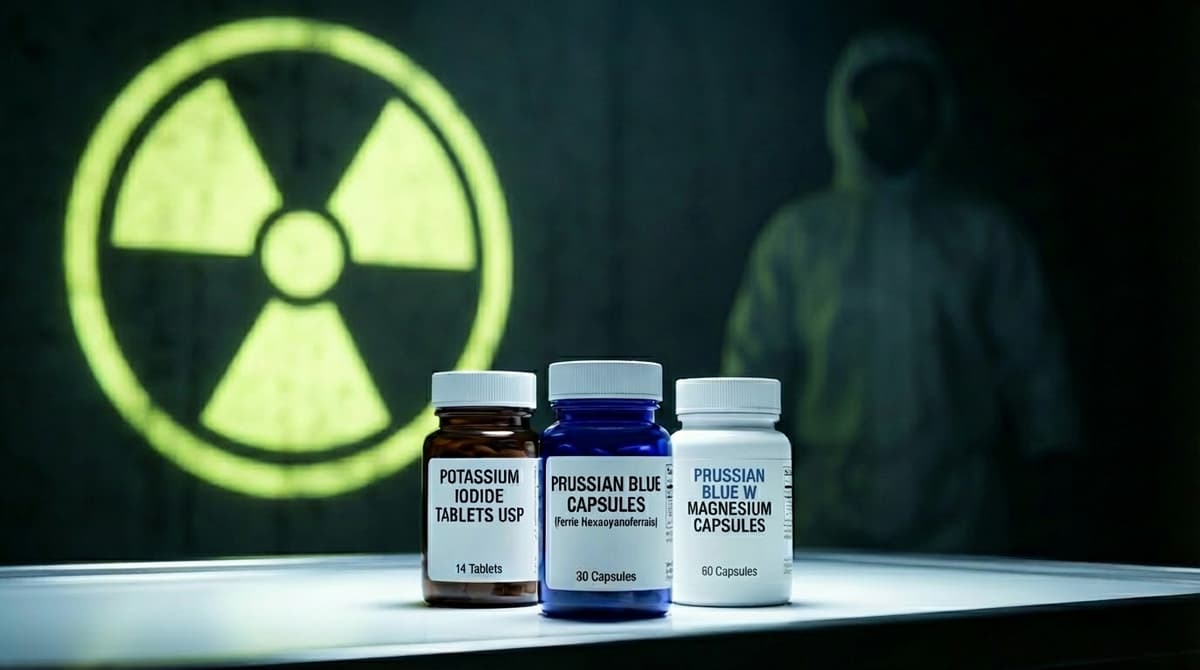
Radioactive contamination from nuclear and radiological incidents involves isotopes with fundamentally different biological behaviors. Iodine-131 targets the thyroid. Cesium-137 distributes throughout the entire body. Thallium attacks the nervous system and vital organs. Each demands a distinct medical countermeasure — and each has a different environmental persistence profile that determines how long the threat remains active.
For governments, hospitals, and defence procurement teams responsible for emergency preparedness, understanding these differences is not academic — it is the foundation of an effective stockpiling and response strategy.
Iodine-131 — Thyroid-Specific Internal Exposure
Iodine-131 (I-131) is one of the most significant fission products released during nuclear incidents. According to the U.S. CDC, I-131 concentrates selectively in the thyroid gland, where its beta and gamma radiation destroys thyroid tissue from within.
- Concentrates in the thyroid gland via the sodium-iodide symporter
- Causes radiation-induced thyroid cancer, particularly in children
- Leads to hormonal dysfunction (hypothyroidism, thyroiditis)
- Can result in permanent thyroid damage requiring lifelong hormone replacement
- Airborne release during the early phase of a nuclear event
- Rapidly enters the food chain — milk, water, and leafy crops
- Spread is local to regional, depending on weather patterns
- Half-life: ~8 days — hazard window extends from weeks to months
The short half-life of I-131 means the contamination window is limited, but the biological damage is concentrated and severe if exposure occurs without thyroid protection in place. Children and pregnant women are at highest risk due to higher thyroid uptake rates.
Cesium-137 — Long-Term Whole-Body Contamination
Cesium-137 (Cs-137) presents a fundamentally different threat. As documented by the IAEA's Goiania accident report, Cs-137 mimics potassium in the body, distributing throughout soft tissue, muscle, and organs — delivering continuous internal irradiation over extended periods.
- Mimics potassium — distributes throughout the entire body
- Delivers continuous internal radiation to soft tissue and organs
- Associated with leukaemia, solid cancers, and immune suppression
- Cardiovascular damage and chronic electrolyte disruption
- Highly mobile in air, soil, and water systems
- Enters the food chain and persists in agricultural soil
- Regional to continental contamination possible (as seen after Chernobyl)
- Half-life: ~30 years — hazard period extends across decades to centuries
The combination of long environmental persistence and whole-body distribution makes Cs-137 the most strategically significant isotope for long-term emergency planning. Institutions without Prussian Blue (Ferric Hexacyanoferrate) in their medical stockpile have no approved decorporation agent available for this threat.
Thallium — Systemic Toxicity and Neurological Damage
Thallium (Tl) — whether in its radioactive or chemical toxic form — presents severe systemic injury. It disrupts potassium-dependent cellular processes throughout the body, with particular damage to the nervous system, kidneys, and liver.
- Disrupts potassium-dependent cellular systems across multiple organs
- Severe neurological damage — peripheral neuropathy, encephalopathy
- Multi-organ failure involving kidneys, liver, and hair follicles
- Potentially fatal toxicity without rapid medical intervention
- Mostly localised contamination — limited long-range environmental dispersion
- Radioactive forms have short half-lives
- Chemical toxicity persists until eliminated medically
- Primarily an ingestion or direct contact hazard
While thallium contamination tends to be more localised than I-131 or Cs-137, the clinical severity is acute. Without treatment, thallium poisoning carries significant mortality risk. Like cesium, the approved decorporation agent is Prussian Blue.
Medical Countermeasures — Targeted Antidotes for Each Isotope
The WHO's updated critical medicines list for radiological and nuclear emergencies identifies the specific countermeasures required for each isotope. The U.S. FDA maintains approved medical countermeasures that align with this guidance.
Potassium Iodide saturates the thyroid gland with stable iodine, blocking the uptake of radioactive I-131. According to FDA guidance, KI is most effective when administered shortly before or immediately after exposure. It is available in two approved strengths: 130 mg and 65 mg tablets.
Critical timing: Effectiveness decreases significantly if administration is delayed beyond the first few hours after exposure.
Prussian Blue (Ferric Hexacyanoferrate) binds cesium and thallium ions in the gastrointestinal tract through ion exchange and adsorption, preventing reabsorption and enhancing faecal elimination. Data from the 1987 IAEA Goiania incident demonstrated a reduction in Cs-137 biological half-life from 110 days to approximately 30 days — a 71% reduction in absorbed dose.
Dual-action: Prussian Blue is the only FDA-approved agent effective against both Cs-137 and thallium contamination.
Institutional note: Potassium Iodide protects only the thyroid from I-131. It has no effect against cesium-137 or thallium. A complete nuclear emergency antidote stockpile requires both KI and Prussian Blue to cover the full spectrum of radiological threats.
Diagnostic Testing and Monitoring Protocols
Each isotope requires specific diagnostic and monitoring approaches to assess internal contamination and guide treatment decisions.
- Thyroid uptake scan (radioiodine uptake measurement)
- Thyroid function panel: TSH, free T3, free T4
- Urinary iodine measurement for exposure assessment
- Serial thyroid monitoring for long-term cancer surveillance
- Whole-body gamma spectrometry (primary diagnostic tool)
- Urine cesium levels for ongoing exposure monitoring
- Blood electrolyte panel — potassium, magnesium balance
- Complete blood count and immune function monitoring
- Blood thallium concentration (ICP-MS — inductively coupled plasma mass spectrometry)
- Urine toxicology screening for thallium excretion monitoring
- Neurological evaluation — nerve conduction studies, cognitive assessment
- Hepatic and renal function panels for organ damage assessment
Comparative Overview — Three Isotopes, Three Threat Profiles
| Parameter | Iodine-131 | Cesium-137 | Thallium |
|---|---|---|---|
| Primary target | Thyroid gland | Whole body (soft tissue, muscle) | Nervous system, kidneys, liver |
| Physical half-life | ~8 days | ~30 years | Short (radioactive forms) |
| Environmental spread | Local to regional | Regional to continental | Mostly localised |
| Approved countermeasure | Potassium Iodide (KI) | Prussian Blue | Prussian Blue |
| Key diagnostic | Thyroid uptake scan | Whole-body gamma spectrometry | Blood thallium (ICP-MS) |
| Hazard duration | Weeks to months | Decades to centuries | Until medical elimination |
Scientific Consensus and Institutional Readiness
The global scientific and regulatory consensus — reflected in guidance from the WHO, IAEA, CDC, and FDA — is clear on several principles:
- Radiation damages cells through DNA ionisation — internal contamination is more dangerous than external exposure because it delivers sustained radiation from within
- Each isotope requires a targeted countermeasure — there is no single universal antidote for all radiological threats
- Early intervention significantly reduces biological damage — delays in administration reduce the effectiveness of both KI and Prussian Blue
- Institutional stockpiling of both Potassium Iodide and Prussian Blue is a preparedness requirement, not a discretionary decision
For institutional buyers and emergency preparedness teams, the operational implication is straightforward: a stockpile that includes only one of these countermeasures leaves a critical gap. Potassium Iodide without Prussian Blue means no protection against cesium or thallium. Prussian Blue without KI means no thyroid protection against I-131.
A complete nuclear emergency medicine stockpile must include Potassium Iodide (KI) for thyroid protection and Prussian Blue (Ferric Hexacyanoferrate) for whole-body decorporation. Together with appropriate diagnostic capabilities and response protocols, these form the foundation of institutional radiological readiness that meets international pharmaceutical and regulatory standards.