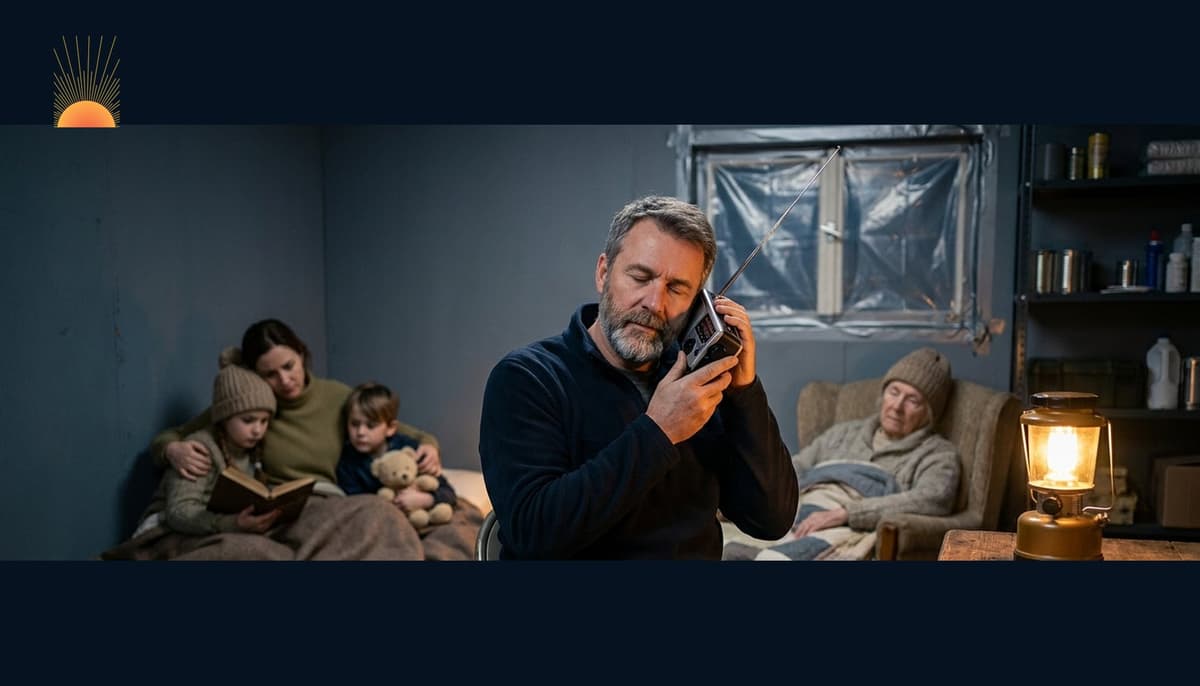
Calm man listening intently to a hand-crank emergency radio inside a sealed safe room while family shelters together — household communication and command protocol
Emergency Medicine

Civilian Emergency Preparedness Manual — Module 3: Communication, Command Structure & Behavioral Protocols

A practitioner's manual for crisis communication and household command discipline during emergency shelter conditions — government alerts, radio lifelines, household incident leadership, behavioral protocols, and season-based survival when electricity fails.

Golden Hour PharmaApril 24, 20264 min read

1. Core Principle of Crisis Communication

In any emergency—whether natural disaster, industrial accident, or chemical/radiological exposure—survival is directly linked to the quality of communication. The sequence is always: right information leads to right decisions, and right decisions lead to correct execution. When communication fails, people act on assumptions, panic spreads, and even well-equipped households become vulnerable. Communication is therefore not just an operational tool; it is a life-saving mechanism that governs behavior, timing, and coordination.

Sources: World Health Organization · International Federation of Red Cross and Red Crescent Societies

2. Government-to-Civilian Communication Systems

Governments communicate through emergency SMS (cell broadcast), official apps, TV alerts, radio, and civil defense loudspeakers. These are directive instructions, not suggestions. Immediate compliance is critical.

Sources: Federal Emergency Management Agency · Ready.gov

3. Communication When Mobile Networks Fail

If mobile and internet fail, the primary survival tool is a battery-operated or hand-crank radio, kept inside the safe room. Passive systems like civil defense loudspeakers or mosque/public announcements become critical.

⚠️ Critical Rule: Do NOT go to a car for radio during chemical/radiological threats due to contamination risk. Car radio is only acceptable if already outside or in non-contamination events.

If forced outside: full covering, minimal exposure, and full decontamination before re-entry.

Sources: Centers for Disease Control and Prevention · World Health Organization

4. Understanding Government Instructions

Shelter-in-place
stay inside, seal room
Evacuate
immediate movement
Lockdown
no movement
Avoid area
stay away completely

Sources: Ready.gov · Federal Emergency Management Agency

5. Household Command Structure

One Household Incident Leader (HIL), one deputy, and defined roles: information, safety, logistics, care.

Sources: Federal Emergency Management Agency · International Federation of Red Cross and Red Crescent Societies

6. Internal Communication Discipline

Single authority, short instructions, confirmation required. No conflicting voices.

Sources: World Health Organization · Centers for Disease Control and Prevention

7. Stay Together vs Split

Default: stay in one sealed room. Split only for infection isolation or structural risk.

Sources: Centers for Disease Control and Prevention · World Health Organization

8. Safe Room Strategy

Interior room, sealed environment, HVAC off, essentials inside.

Sources: Ready.gov · Federal Emergency Management Agency

9. Children Handling

Keep with caregiver, no exposure to panic, maintain calm engagement.

Sources: UNICEF · Centers for Disease Control and Prevention

10. Elderly & Sick

Prioritize medication, comfort, and assign dedicated caregiver.

Sources: World Health Organization · Centers for Disease Control and Prevention

11. Behavioral Protocol

Stay calm, follow instructions, avoid rumors and panic actions.

Sources: World Health Organization · International Federation of Red Cross and Red Crescent Societies

12. Communication Equipment

Phones, power banks, and mandatory radio with spare batteries.

Sources: Ready.gov · Federal Emergency Management Agency

13. Communication Failure Plan

Pre-decided meeting points, written signals, neighbor coordination.

Sources: Ready.gov · International Federation of Red Cross and Red Crescent Societies

14. Misinformation Control

Only verified sources, no forwarding unverified content.

Sources: World Health Organization · Centers for Disease Control and Prevention

15. Leadership & Stability

Calm leadership directly improves survival and execution quality.

Sources: World Health Organization · International Federation of Red Cross and Red Crescent Societies

16. Children & Elderly Comfort & Engagement (Critical Human Factor)

Children must be kept engaged with toys, books, coloring materials, or silent games to reduce panic and psychological stress. Comfort items like blankets or familiar objects should always be available. Routine-like structure (rest, eat, sit cycles) stabilizes their behavior. Elderly individuals must be kept comfortable, medicated, and emotionally reassured. Both groups must stay with assigned caregivers at all times. Hydration, ventilation control, and continuous monitoring are essential.

Sources: World Health Organization · UNICEF · Centers for Disease Control and Prevention

17. No Electricity Scenario (Season-Based Survival Protocol)

During power loss, use battery lighting and radios. Avoid unsafe flames in hazardous conditions.

Summer
Stay in coolest interior room, use damp cloth cooling, hydrate frequently, reduce activity.
Winter
Stay together in one room, use layered clothing and blankets, block drafts safely.
Rain/Flood
Move to elevated safe area, protect supplies from water, avoid contaminated floodwater.
Autumn/Spring
Maintain balanced ventilation if safe, focus on stability and hydration.

Across all seasons: never compromise sealed safety during contamination events.

Sources: World Health Organization · Federal Emergency Management Agency · Centers for Disease Control and Prevention

Final Doctrine

House = Shield

Safe Room = Protection Zone

Radio = Lifeline

Discipline = Survival Advantage

Communication = Life Preservation System

Closing Statement

"In crisis, survival belongs not to the strongest, but to those who stay informed, stay united, and act with discipline under pressure."

Coming Next: Module 4 — arriving soon. Stay tuned.

Pharmaceutical Preparedness

Ready When It Matters Most

Golden Hour Pharma supports healthcare systems, institutions, and emergency preparedness efforts with critical medicines, strategic supply planning, and responsive pharmaceutical support across high-risk environments.

WHO-GMP Certified · Strategic Stockpiling · Emergency Supply