
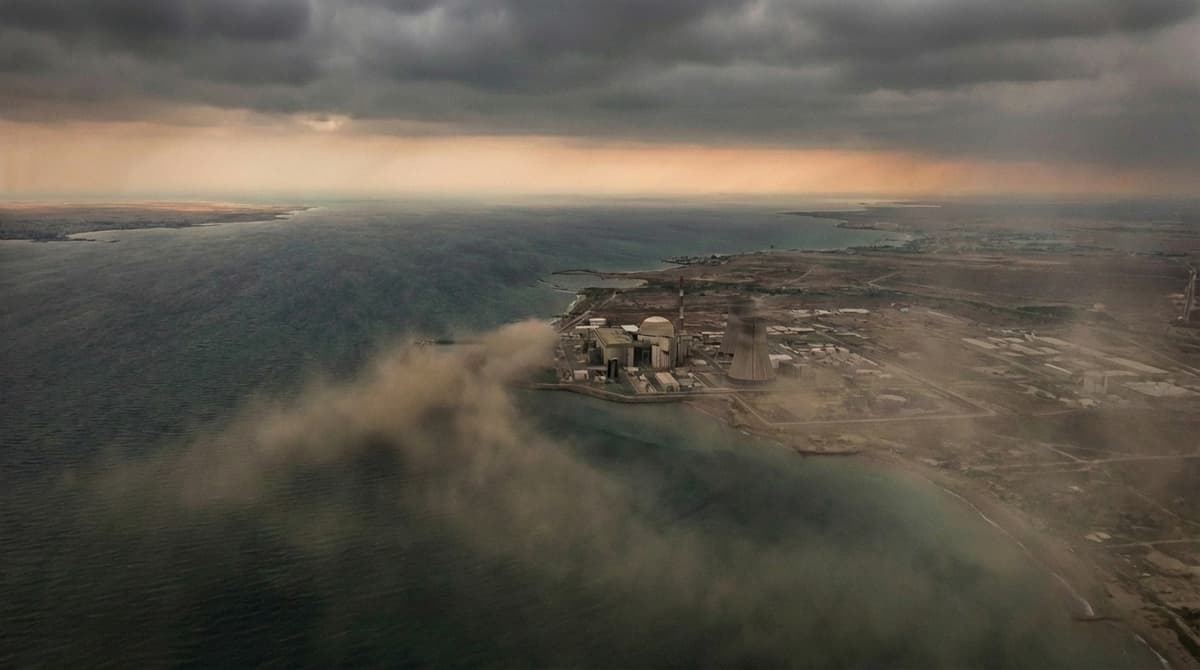
The Bushehr Nuclear Power Plant, located on Iran's Persian Gulf coastline, represents one of the most geopolitically sensitive nuclear facilities in the world. As regional tensions intensify, scenario planning for a potential attack is no longer theoretical — it is a scientific and humanitarian obligation. This analysis examines what would happen: how radiation spreads through air, water, and surface pathways, which populations are at risk, and what medical countermeasures nations must have in place.
Science is established. Risks are known. Solutions exist. The only gap is execution and readiness.
Reactor Design & Containment Reality
The Bushehr plant operates a VVER-1000 pressurized water reactor — a Russian-designed system incorporating multiple layers of engineered safety barriers. Understanding the reactor's architecture is essential for assessing the realistic scope of any radiological release.
VVER-1000 Reactor — Key Safety Features
- Reinforced steel–concrete containment dome designed to withstand significant structural stress
- Multiple engineered safety barriers between the fuel core and the environment
- Pressurized water design limits the risk of steam explosion compared to earlier reactor generations
- Passive safety systems that activate automatically in the event of power loss
This design significantly reduces the likelihood of a Chernobyl-type open explosion — however, in a severe attack scenario, controlled or partial radioactive leakage remains scientifically plausible.
Source: International Atomic Energy Agency (IAEA)
Damage Scenarios
Not all attack scenarios produce equal outcomes. The scale of radionuclide release depends heavily on the nature and severity of the damage. Release is progressive and multi-phase — not instantaneous.
Moderate Damage
Localized release of radionuclides. Containment partially intact. Primary risk to immediate surrounding area and facility workers.
Severe Damage
Core overheating or containment breach. Significant radionuclide release into atmosphere and potentially waterways. Regional impact across multiple countries.
Source: International Atomic Energy Agency (IAEA)
Radioactive Elements Released
A containment breach releases multiple radionuclides simultaneously, each with distinct biological pathways and organ targets. Understanding these elements is the foundation for deploying the correct medical countermeasures.
☢ Iodine-131 — Thyroid Seeker
Iodine-131 is one of the most dangerous short-term releases from a nuclear incident. It concentrates in the thyroid gland within hours of inhalation or ingestion, causing radiation-induced thyroid cancer, nodules, and hormonal imbalance. Children and pregnant women face the highest risk.
Primary health impact: Thyroid cancer, hypothyroidism, hormonal disruption
☢ Cesium-137 — Whole-Body Contaminator
Cesium-137 behaves like potassium in the body and distributes into soft tissues throughout the entire organism. With a 30-year half-life, it persists in the environment for decades, contaminating soil, crops, and water. Long-term exposure causes leukemia, solid cancers, and immune suppression.
Primary health impact: Leukemia, multiple cancers, immune suppression, multi-organ damage
☠ Thallium — Neurological Threat
Thallium is one of the most acutely toxic heavy metals that can be released during a nuclear incident. It attacks the nervous system, disrupts cellular metabolism, and causes progressive multi-organ failure. Even small doses produce severe neurological damage.
Primary health impact: Neurological damage, hair loss, peripheral neuropathy, multi-organ failure
Sources: UNSCEAR — United Nations Scientific Committee on the Effects of Atomic Radiation; World Health Organization (WHO)
Airborne Dispersion — Wind Pathway
Airborne radionuclides travel rapidly across borders. Atmospheric transport systems in the Persian Gulf region — including the powerful Shamal winds — can carry contamination across multiple nations within hours. Understanding the timeline is critical for evacuation and countermeasure deployment.
Airborne Spread Timeline
- 0–6 hours
Local high-concentration plume — immediate threat zone around the facility, highest exposure levels
- 6–24 hours
Downwind coastal atmospheric spread — contamination reaches populated coastal regions
- 24–48 hours
Regional atmospheric dispersion — radionuclides cross into neighboring countries
- 48–72 hours
Wider diluted atmospheric reach — broader regional deposition, lower concentrations but sustained exposure
Sources: World Meteorological Organization (WMO); International Atomic Energy Agency (IAEA)
Air Impact Zones — Distance-Based Model
Atmospheric dispersion follows predictable distance-based zones. The highest exposure risk is always nearest to the source, but even diluted concentrations reaching distant zones carry significant long-term contamination potential.
Zone 1 — 0–6 hrs
Immediate Plume Zone
Highest concentration of radionuclides. Direct inhalation risk. Mandatory evacuation and shelter-in-place protocols.
Zone 2 — 6–24 hrs
Downwind Transport Zone
Atmospheric transport carries particles across the Persian Gulf coastline. Iodine-131 inhalation risk. KI deployment critical.
Zone 3 — 24–72 hrs
Regional Deposition Zone
Diluted but persistent radionuclide deposition across multiple nations. Long-term soil and surface contamination begins.
Source: UNSCEAR — United Nations Scientific Committee on the Effects of Atomic Radiation
Marine Dispersion Pathway
The Bushehr plant sits directly on the Persian Gulf shoreline. If radionuclides enter the water — through runoff, cooling water discharge, or atmospheric deposition onto the sea surface — marine dispersion follows Gulf current patterns with cascading consequences for fisheries, coastal populations, and drinking water supplies across the region. The Fukushima Daiichi disaster provides a documented reference model.
Marine Dispersion Timeline
- 0–24 hours
Coastal surface contamination begins — fishing bans and water intake alerts required immediately
- 1–7 days
Near-coastal spread via Gulf currents — contamination reaches neighboring states' territorial waters
- 1–4 weeks
Sediment binding and long-term marine persistence — benthic contamination affecting seafloor ecosystems for years
Reference: Fukushima Daiichi nuclear disaster marine dispersion data. Sources: International Atomic Energy Agency (IAEA); UNSCEAR
Desalination Plant Impact
The Persian Gulf supplies the primary seawater intake for desalination plants across Saudi Arabia, Kuwait, the UAE, Bahrain, Qatar, and Iran itself. These plants — which produce drinking water for tens of millions of people — become a critical vulnerability if marine contamination occurs. Standard desalination processes do not remove radionuclides.
Desalination Contamination Risk Timeline
- 0–12 hours
Contaminated seawater intake risk begins — plants drawing from affected coastal zones must halt operations immediately
- 12–48 hours
Operational contamination risk — any plant continuing intake during this window risks introducing radionuclides into distributed drinking water
- 2–7 days
System disruption risk — extended shutdown of desalination capacity across the Gulf region creates compounding humanitarian crisis
Sources: World Health Organization (WHO); International Atomic Energy Agency (IAEA)
Surface & Ground Contamination
As the airborne plume travels and disperses, radionuclides settle onto surfaces through dry deposition and wet deposition (rainfall). Surface contamination is particularly insidious — it contaminates agricultural land, rooftops, vehicles, and open water sources while remaining invisible to the naked eye.
Surface Contamination Timeline
- 0–24 hours
Dry deposition on surfaces begins — radionuclides settle on buildings, vegetation, vehicles, and open water
- 1–3 days
Rainfall washout intensifies contamination — precipitation drives radionuclides into soil and surface water sources
- 3–14 days
Soil absorption and long-term ground contamination — Cesium-137 binds strongly to clay minerals, creating persistent ground contamination lasting decades
Source: UNSCEAR — United Nations Scientific Committee on the Effects of Atomic Radiation
Overall Scientific Summary
Radiation dispersion is multi-path and time-layered. Each pathway — air, water, and surface — operates on its own timeline and requires a specific response. The interaction between these pathways amplifies total exposure risk for regional populations.
Air Spread
Hours to 72 hours
Water Spread
Hours to weeks
Surface Contamination
Hours to weeks
Infrastructure Impact
Hours to days
Medical Countermeasures — The Critical Survival Layer
Radiation leads to internal contamination that requires targeted pharmaceutical intervention. Two antidotes form the essential backbone of any national nuclear emergency response. Without them, exposure progresses unchecked through the body.
Potassium Iodide (KI)
Saturates the thyroid gland with stable iodine, blocking uptake of radioactive Iodine-131. Must be administered before or immediately after exposure to be effective. Protects the thyroid from radiation-induced cancer.
Target: Iodine-131 — Thyroid protection
Prussian Blue (Ferric Hexacyanoferrate)
Binds Cesium-137 and Thallium in the gastrointestinal tract, preventing reabsorption and accelerating elimination via feces. The only FDA and WHO-approved treatment for internal Cesium-137 and Thallium contamination.
Target: Cesium-137 & Thallium — Whole-body decontamination
Global Guidance Authorities
The use of KI and Prussian Blue in nuclear emergencies is endorsed by the World Health Organization (WHO), the Centers for Disease Control and Prevention (CDC), and the U.S. Food and Drug Administration (FDA) as the standard of care for radiological internal contamination.
The Global Preparedness Gap
Despite clear scientific guidance, the vast majority of nations maintain critically incomplete stockpiles. This gap is not a funding problem — it is a knowledge and prioritization problem. The consequences are measurable in human lives.
Current State — Most Nations
- Stockpile KI only — partial thyroid protection
- No Prussian Blue in national emergency reserves
- No protection against Cesium-137 or Thallium exposure
- Multi-isotope scenarios not covered by existing protocols
Required Shift — Complete Preparedness
- Inclusion of Prussian Blue in national stockpiles
- Multi-isotope preparedness strategy aligned with IAEA guidance
- Pre-positioned antidotes in proximity to nuclear facilities
- Training protocols for rapid countermeasure deployment
KI protects only iodine exposure. It does not protect against Cesium-137 or Thallium. Nations relying solely on KI stockpiles are leaving their populations unprotected against the most persistent and damaging radionuclides released in a nuclear incident.
Golden Hour Pharma — Ready When It Matters Most
We are not just a company — we are a force. Golden Hour Pharma specializes in nuclear emergency antidotes and crisis-ready pharmaceutical supply. Our capabilities are purpose-built for exactly the scenarios outlined in this analysis.
Core Capabilities
- WHO-approved manufacturing facility — pharmaceutical-grade production standards
- Specialized in nuclear emergency antidotes — KI, Prussian Blue, and advanced formulations
- Crisis & disaster management expertise — experienced in high-urgency institutional procurement
Product Portfolio
750+ products — Sterile & Non-Sterile
- Tablets & Capsules
- Injectables
- Ointments
- Eye & Ear Drops
Global Presence
Supplying 30+ Countries
- Regional partners in Saudi Arabia
- UAE & Bahrain
- Active supply networks across MENA
- Rapid deployment capability globally
Where Others Struggle
- Competitive pricing pressure
- Complex logistics barriers
- Emergency delivery failures
We Ensure
- Affordable, competitive pricing
- Rapid and timely delivery
- Crisis-ready supply capability
Innovation Leadership — Prussian Blue + Magnesium
Golden Hour Pharma is the only company introducing a Prussian Blue + Magnesium formulation. Magnesium reduces gastrointestinal side effects, supports electrolyte stability, enhances cardiovascular safety, and improves tolerance in prolonged treatment.
Frontliners
Prussian Blue + Magnesium — enhanced tolerance for sustained exposure scenarios
Civilians
Standard Prussian Blue — proven WHO/FDA-approved formulation for population-level distribution
Final Message
In nuclear emergencies, three variables define outcomes: time defines exposure, treatment defines survival, and preparedness defines outcome. The Bushehr scenario is not hypothetical — it is a documented risk in one of the world's most volatile regions, affecting some of its most densely populated coastlines and water-dependent populations.
Nations that stockpile only Potassium Iodide are preparing for one isotope in a multi-isotope emergency. Nations that add Prussian Blue to their reserves — and train for its deployment — are nations that protect their people comprehensively.
Preparedness today will define survival tomorrow.
Golden Hour Pharma—Ready when it matters most.
Procurement Resources
- Potassium Iodide (KI) — Pharmaceutical Grade Institutional Supply
- Prussian Blue (Ferric Hexacyanoferrate) — Radiation Decontamination Supplier
- Potassium Iodate (KIO3) — Thyroid Protection for Institutional Stockpiles
- Full Nuclear Emergency Antidote Range
- Emergency Medicine Procurement — Institutional Supply Partner